
Xinjiang Aid operates as colonial governance and weaponized development, as evident in the cases of Hotan and Kashgar. Through the pairing-assistance (对口援疆) mechanism, provinces in inner China assume direct responsibility for administering, reorganizing and reshaping parts of the Uyghur Region, effectively managing, exploiting and ideologically transforming the region to serve the Chinese Communist Party’s interests. Hotan, an early pilot site for cadre embedding and industrial “aid,” and Kashgar, a major “labor-export” hub, demonstrate how Xinjiang Aid channels cadres, capital and industries into the region while extracting and and dispersing Uyghur workers across China with state-imposed forced labor. For these workers, labor transfers entail displacement, family separation, and forced assimilation in the name of “employment” and “poverty alleviation.”
Why Hotan and Kashgar?
These southern prefectures of the Uyghur Region are key sites for Xinjiang Aid’s pairing-assistance because they have high densities of Uyghur populations, predominantly rural communities, relatively strong religious observance and socially conservative traditions. As such, Hotan and Kashgar have become key “battlegrounds” for Xinjiang Aid’s dual purpose: channeling labor and resources into state-led industries while dismantling local identity and lifeways through displacement, dispersion and cultural ideological transformation.
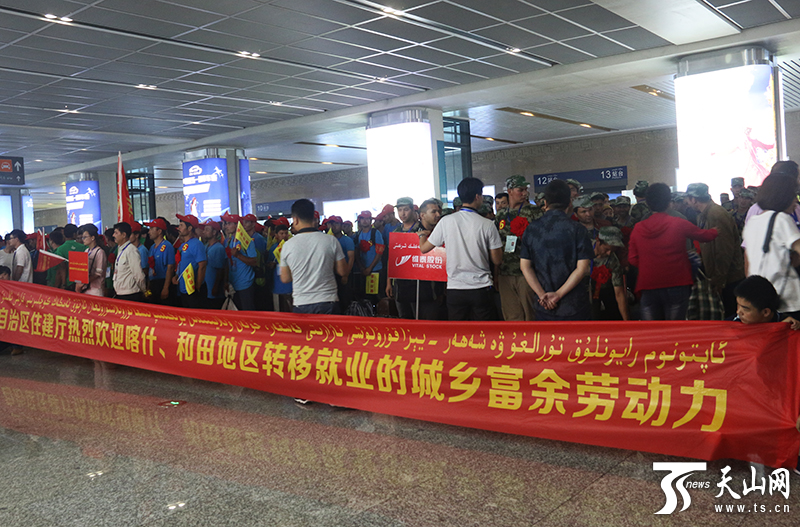
On July 16, 2017, 882 workers labeled as “urban and rural surplus labor” from Kashgar and Hotan arrived in Urumqi. The Director of the Autonomous Region’s Housing and Urban–Rural Development Department told them to devote themselves to their new jobs “with gratitude” and to “feel the Party’s favor, listen to the Party, and follow the Party.”
Ⓒ Department of Housing and Urban-Rural Development of XUAR
Hotan
Hotan, an oasis in the southwest of the Uyghur Region, lies at the heart of Xinjiang Aid’s colonial paradigm. Transfers on the present scale grew from years of bureaucratic experimentation. As early as 2005, central authorities designated Hotan City among the first pairing-aid localities, embedding Party secretaries from inner China provinces into local government to “guide governance” and accelerate assimilation. This model of cadre embedding foreshadowed later mechanisms of external control that would come to define the “Strike Hard” era in late 2016, during which international observers documented crimes against humanity and genocide.
Following the launch of Strike Hard Campaign Against Violent Terrorism, Beijing reframed labor transfers as “poverty alleviation” measures to legitimize its increased securitization of the Uyghur Region. Independent investigations by Australian Strategic Policy Institute (ASPI), The New York Times, and The Bureau of Investigative Journalism have identified Hotan among the Uyghur Region’s leading sending areas for labor transfers.
According to the State Council’s 2020 White Paper on labor in the Uyghur Region, more than 221,000 people from the south (including Hotan and Kashgar) were transferred between 2017 and June 2020. Chinese state-media reports cite the transfer (per times) of more than “600,000 surplus labor” from Hotan in 2018 alone, with nearly 200,000 transferred out of the prefecture and 14,500 transferred to inner China, generating 4.7 billion yuan in labor revenue.
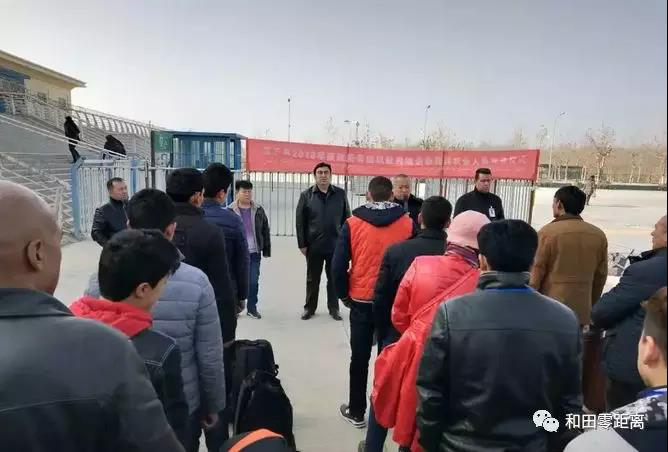
To facilitate these transfers, Xinjiang Aid partners embedded administrative, technological, and ideological infrastructures directly into Hotan. Inner China provinces including Anhui, Zhejiang, Beijing and Shanghai jointly funded textile and garment industrial parks, Mandarin-language instruction, housing projects and transport infrastructure under the banner of poverty alleviation and ethnic unity. The Xinjiang Human Resource Department coordinated with provincial counterparts to institutionalize large-scale training and labor dispatch mechanisms. The U.S. government has designated several of these industrial parks and enterprises participating in these schemes on the UFLPA Entity List for their documented ties to coercive labor transfer programs.
In 2023, People’s Daily reported Anhui Province received more than 5,000 workers from the Southern Uyghur Region, including Hotan and Kashgar, and “resettled 295 minority households.” Prefectural bulletins in Hotan describe the Yutian County Industrial Park absorbing over 900 farmers into factory “skilled-worker” posts. Earlier, in 2018, China National Radio, detailed the transfer of thousands of Hotan and Kashgar farmers and herdsmen into state-owned enterprises following recruitment and training campaigns run by local human resource and social security offices. These transfers mark a deliberate displacement and erosion of traditional Uyghur livelihoods —historically rooted in small-scale agriculture, herding, and local market economics—into regimented factory systems.
Through the pairing programmes, Hotan thus becomes a peripheral labor colony: injecting state cadres and capital while extracting labor and reshaping society under ideological supervision. Independent investigations by Australian Strategic Policy Institute (ASPI) link training and work-facilities to the perimeters of internment camps, revealing the nexus between “re-education” and industrial exploitation.
Kashgar
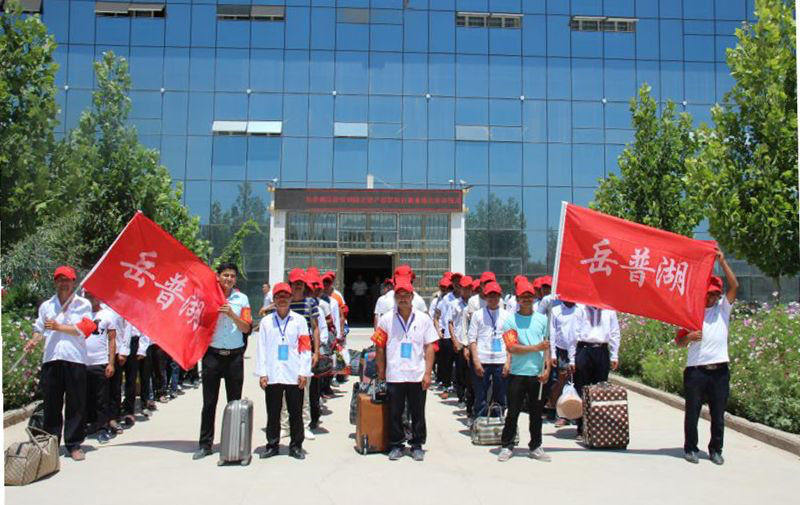
Kashgar Prefecture represents the labor export frontier of Xinjiang Aid. Following the 2010 Xinjiang Work Forum, Shandong Province assumed direct responsibility for Kashgar’s pairing assistance, operating it as a de facto provincial “development zone.” This arrangement granted Shandong officials broad authority over investment, labor placement and transfers, and ideological programming in the Uyghur Region with minimal local oversight.
By 2018, Shandong officials claimed they had transferred 6,600 Kashgar residents under highly structured “labor-dispatch” (劳务输出) campaigns. They subsidized enterprises that hired transferred workers and required counties to run recruitment fairs to hit quotas.¹⁴ The province also enforced a “three-person accompaniment” model (三人伴随机制), in which a village cadre, labor broker, and destination manager escort and supervise Uyghur workers from origin to destination.
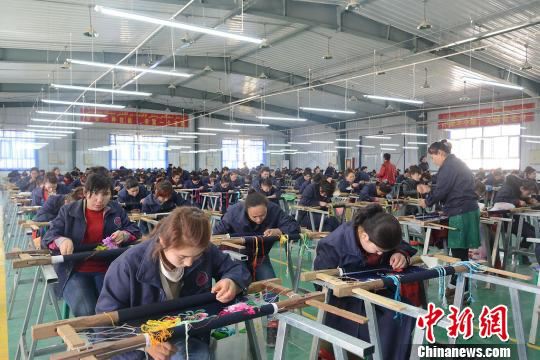
Between 2022 and 2024, Kashgar dominated the Uyghur Region’s employment-transfer bulletins. The Kashgar Regional Administrative Office set a goal of 800,000 rural labor transfers for 2023 along with 150,000 various vocational skills training. State media and provincial press reported transfers to Shandong, Guangdong, and Henan while the New York Times traced Kashgar-origin workers into electronics, seafood, and garment factories across eastern China.
Ⓒ Sohu.com
Industrial parks and infrastructure projects under pairing aid reinforced Kashgar’s dependency and reconfigured the local economy. Shandong built textile and food-processing parks in Kashgar branded as “poverty alleviation zones” while using them to absorb Uyghur labor into regimented production hubs. Factories built under aid agreement effectively became instruments of surveillance and assimilation: cadres monitored political behavior on the production line, banned Uyghur language use, required daily national anthem and flag raising ceremonies, and prohibited religious practice. These conditions are corroborated by testimonies from Uyghur workers and by independent reporting from the ASPI, The New York Times, The Bureau of Investigative Journalism, Human Rights Watch, and the Uyghur Tribunal.
Call to Action
Uyghur Rights Monitor echoes the Coalition to End Forced Labour in the Uyghur Region’s Call to Action, which urges companies to fully disengage from the Uyghur Region and from any supplier or facility—inside or outside China—linked to state-sponsored labor transfers. No credible audits or due-diligence mechanisms can operate under current conditions. The Coalition calls on brands, investors and governments to adopt and enforce a single, global standard consistent with the UN Guiding Principles and laws such as the Uyghur Forced Labor Prevention Act.