
Ablet Turdi and Erk Altay
EXECUTIVE SUMMARY
The Chinese government has built an integrated digital surveillance apparatus in East Turkestan (officially called Xinjiang Uyghur Autonomous Region) as part of its broader campaign of repression and genocide against Uyghurs and other Turkic peoples. Authorities combine biometric data collection, predictive policing, mobile phone inspection, household registration, and public service applications within a single unified public security system that enables continuous monitoring and policing of everyday life.
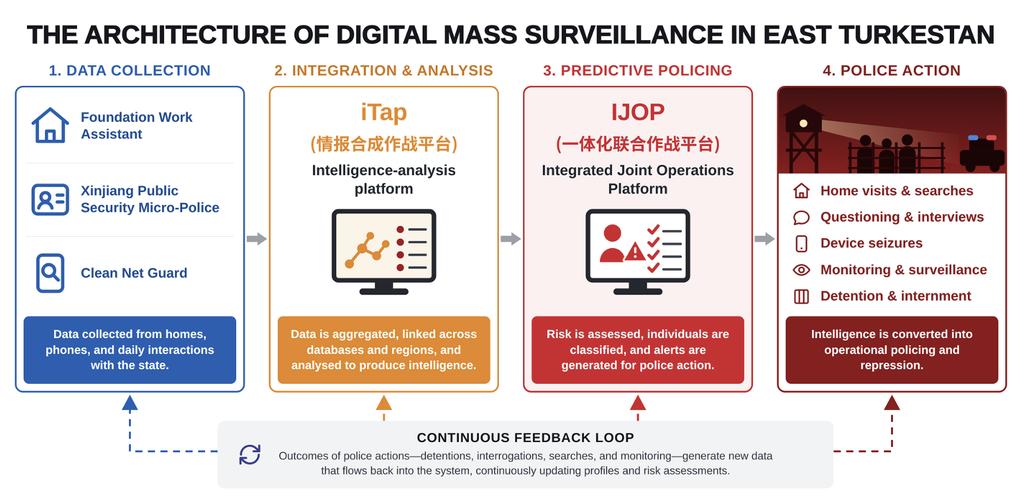
This report examines five software platforms that operate within that architecture: iTap (情报合成作战平台), Xinjiang Public Security Micro-Police (新疆公安微警务), Foundation Work Assistant (基础工作小助手), Clean Net Guard (净网卫士), and Integrated Joint operations Platform (IJOP,一体化联合作战平台). Although each platform performs a different function, they form successive stages in a single surveillance process. Data collected from households, mobile devices, and routine interactions with government services flows into centralized intelligence systems, where data is analyzed, linked across databases, and converted into police action.
Building on existing research findings, Uyghur Rights Monitor analyzed Chinese-language government documents, corporate records, procurement materials, software registrations and identified each platform’s developer, intended users, documented functions, and role within China’s broader surveillance architecture.
Key Findings
- The five platforms function as an integrated surveillance architecture in East Turkestan. Household registration, biometric verification, mobile phone inspection, and government services generate data that centralized intelligence systems analyze and convert into operational policing decisions targeting Uyghur and other Turkic populations.
- Routine administrative services double as mechanisms of surveillance. Xinjiang Public Security Micro-Police integrates police services, electronic identity certificates, facial verification, and government records into a single interface, while Foundation Work Assistant transforms household registration into GPS-tagged intelligence collection.
- Back-end analytical platforms translate ordinary behavior into risk signals for police attention. iTap and IJOP, and Clean Net Guard aggregate identity, movement, relationship, behavioral, and device data to classify individuals according to predefined categories for police attention. IJOP’s 36 “person types,” including unauthorized Hajj, unofficial imams, or “off-grid,” behavior recharacterize ordinary religious and social activities as indicators of extremism.
- A network of state-owned, private, and foreign firms sustains the surveillance apparatus. CETC affiliates built IJOP and the Xinjiang Public Security Micro-Police, while Landasoft and Hi-Target supply intelligence analysis, phone-inspection, and GPS field applications. Foreign technologies, including Thermo Fisher DNA sequencing kits and IBM’s i2 analytical model, incorporated into Landasoft’s iTap platform, also form part of the broader surveillance ecosystem.
Introduction
Since 2014, the Chinese government has intensified its campaign of control in East Turkestan under the banner of the “People’s War on Terror” and the “Strike Hard Campaign Against Violent Terrorism.” Following Chen Quanguo’s appointment as Party Secretary in 2016, these policies expanded into a comprehensive system of mass internment, forced assimilation, and other genocidal policies targeting the Uyghurs and other Turkic peoples. Since 2017, more than one million Uyghurs and other Turkic people have been detained in internment camps and related facilities.
This campaign also has transformed East Turkestan into one of the world’s most technologically sophisticated surveillance environments. Alongside mass detention and coercive assimilation, the Chinese government expanded biometric data collection, predictive policing, mobile phone inspection, household registration, and public security big data systems across the region. Programs such as “Physicals for All” collected DNA, iris scans, fingerprints, facial images, voice samples, and other biometric identifiers, while police software integrated identity records, movement histories, device information, and behavioral indicators into centralized intelligence platforms.
Surveillance in East Turkestan serves a broader purpose than observation. It functions as the administrative infrastructure through which repression is organized, automated, and embedded into everyday life. This report examines that technical apparatus through five software platforms operating within East Turkestan’s public security system. It analyzes how software platforms, state-linked technology companies, and publicly listed firms operationalize digital surveillance. Taken together, these systems reveal an integrated architecture that transforms administrative interactions into intelligence, intelligence into suspicion, and suspicion into police action.
Methodology
This report uses an open-source research methodology to examine five surveillance platforms operating in East Turkestan. Analysis of IJOP and Clean Net Guard relies primarily on investigations conducted by Human Rights Watch and the Open Technology Fund, including reverse-engineering, source-code analysis, application permission review, and documentation of system architecture and data flows. Analysis of iTap, Xinjiang Public Security Micro-Police and Foundation Work Assistant draw primarily on original research by Uyghur Rights Monitor, using Chinese language sources, including public security announcements, corporate materials, archived webpages, procurement documents, software copyright registrations, application metadata, product descriptions, and local government and media reports. These materials identify each platform’s developer, intended users, stated functions, documented data inputs, and relationships to the wider public security system.
This methodology has several limitations. Uyghur Rights Monitor could not independently obtain or reverse engineer every application examined, particularly iTap, Xinjiang Public Security Micro-Police, and Foundation Work Assistant. Analysis of these platforms relied on information disclosed through official Chinese sources rather than direct technical testing.
The available evidence demonstrates how biometric verification, mobile phone inspection, household registration, identity records, intelligence analysis, and predictive policing operate as interconnected components of a unified surveillance apparatus. Examining these systems together makes it possible to understand not simply how individual applications function, but how digital surveillance is institutionalized across everyday life in East Turkestan.
Analysis: Surveillance Apparatus Penetrates Everyday Life of Uyghurs
The five platforms examined in this report form successive stages of a holistic surveillance process. Data is first collected from people’s homes, bodies, mobile phones, and everyday interactions with the state. That information is then pooled and analyzed in back-end platforms that link identities, movements, relationships, and behavior across multiple databases. Finally, predictive policing systems transform those data into operational decisions, directing officers toward individuals flagged for investigation, monitoring, or detention.
Data Collection at the Door and in the Home
The surveillance apparatus begins at the household. The Foundation Work Assistant (基础工作小助手) enables community police, auxiliary police, grid workers, and “Fanghuiju” (访惠聚) cadres to conduct GPS-tagged, door-to-door population registration. Every visit records where a household is located, who resides there, and who has recently moved, following the doctrine of “not missing one household, not missing one room, not missing one person.”
The application transforms what appears to be routine administrative work into a standardized intelligence collection process. Supervisors assign field inspections through the application, directing officers to apartment compounds, dormitories, villages, and guesthouses. Upon arrival, the application records the officer’s GPS coordinates, retrieves the registered address through a QR code scan, and prompts the collection of information on residents, particularly those absent from official registration records. Officers upload photographs and complete standardized reporting fields before filing the visit. Supervisors simultaneously monitor these activities through a “remote zero distance supervision” dashboard that tracks each visit location, timestamps, and officer productivity, while records involving border or cross-jurisdiction cases are automatically forwarded to neighboring police stations.
Rather than produce a one-time census, the system continuously updates a georeferenced record of households and their occupants. Every move into or out of a residence becomes part of an evolving intelligence database available to public security authorities. This system embeds state personnel and digital data collection into private homes. In East Turkestan, “floating population” management disproportionately targets Uyghur internal migrants, while the Fanghuiju (访惠聚) program places cadres inside Uyghur households. Foundation Work Assistant digitize those encounters, converting each household visit into a permanent, searchable record that downstream intelligence systems such as iTap and IJOP can analyze and operationalize.
Data Collection Through Mobile Phones and Government Services
Data collection does not stop at the door. It extends into residents’ phones and routine interactions with government services, ensuring that ordinary administrative activities continuously generate surveillance data.
Xinjiang Public Security Micro-Police (新疆公安微警务) exemplifies this approach. The WeChat mini program provides access to 89 categories of police and administrative services, including household registration, identity cards, driver’s licenses, and border zone permits. To use the platform, residents register under their real identities. Accessing an electronic certificate requires facial recognition each time it is displayed, including during common activities such as hotel check-in.
The platform merges convenience with surveillance. Residents submit applications, retrieve official documents, and complete identity verification through a single interface connected to the region’s broader public security network. Each transaction creates a dated biometric verification linked to an individual’s identity, service history, and interactions with government agencies. Routine civic transactions thus become another source of intelligence for authorities.
Clean Net Guard (净网卫士) reaches further still, by turning residents’ smartphones into inspection points. Marketed as an application that protects users from harmful or illegal content, the Android application recursively scans device storage, computes digital fingerprints for every file, compares them against a remotely maintained blacklist, and transmits device identifiers (IMEI, MAC, IMSI) to a server associated with Landasoft’s iTap platform.
Unlike centralized monitoring systems, Clean Net Guard operates directly on the user’s device. Once installed, it inventories files stored on the phone, compares them with state defined prohibited content, and reports the results to backend servers. When it identifies a prohibited file, the application may document the result, preserve evidence, and delete the original from the device. The identifiers and file data are sent to a fixed address built into the app, bxaq.landaitap.com, which links to Landasoft’s iTap line. The phone thus becomes an extension of surveillance infrastructure, continuously evaluating personal digital content against government defined standards.
Together, these platforms transform ordinary daily activities into sources of police intelligence. Applying for a permit, checking into a hotel, displaying an identity document, or simply carrying a smartphone generates biometric, identity, behavioral, and device data that flows into the public security system. Surveillance extends beyond individuals already under investigation to the wider population, disproportionately targeting Uyghurs, whose everyday activities become a continuous source of state intelligence.
Translating Data into Police Action
The surveillance system’s coercive power lies in its ability to aggregate data collected from multiple sources, analyze relationships and patterns, classify individuals according to predefined indicators of risk, and direct police action. Within this architecture, iTap functions as the principal intelligence analysis platform while IJOP translate intelligence into operational policing.
iTap: Integrating Intelligence Across People, Place, and Time
iTap (情报合成作战平台) serves as the analytical core of the surveillance apparatus. Developed by Shanghai Landasoft Data Technology, the platform consolidates data from public security systems and other government sources into a searchable intelligence environment. According to the company’s promotional materials, iTap indexes approximately 54 million “high-risk persons” and up to 30 billion trajectory records drawn from more than ten provinces.
Rather than storing isolated records, iTap reconstructs relationships between people, locations, devices, and events. Officers can identity the individual behind an online alias, reconstruct their past movements, map social networks through shared hotels, transportation, mobile phones, or internet cafes, and retrieve previously unknown associates through automated relationship analysis. iTap’s geographical query interface allows investigators to build complex analytical models without specialized technical knowledge, while its “Tactical Alliance” framework enables public security agencies to share intelligence, analytical methods, and case data across jurisdictions, enabling surveillance data from East Turkestan to circulate throughout the national public security network.
The platform serves multiple levels of China’s public security apparatus. Senior leadership uses it to monitor regional security trends and allocate resources, frontline officers conduct rapid identify checks and case analysis, and specialized units including criminal investigation, intelligence, counterterrorism, public order, and narcotics divisions use the system to support investigations. Xinjiang authorities reportedly used the platform to investigate the 2013 Tiananmen vehicle attack, indicating its operational use in active cases.
IJOP: Converting Intelligence into Police Action
If iTap functions as the surveillance system’s analytical brain, the Integrated Joint Operations Platform (IJOP, 一体化联合作战平台) serves as its operational engine. Developed by Hebei Far-East Communications Systems Engineering, a subsidiary of China Electronics Technology Group Corporation, IJOP aggregates information from field officers and technical surveillance systems before generating real-time warnings and directing police intervention.
The platform continuously retrieves data from multiple sources. Field officers upload records collected during household visits, street inspections, political education sessions, and travel registration procedures. These inputs are combined with data from facial recognition cameras, wireless network sniffers, vehicle checkpoints, visitor management systems, package delivery records, mobile phone infrastructure, and government databases. IJOP links each record to an individual’s national identification number, consolidating disparate forms of information into a single profile.
IJOP analyzes these records for what officials describe as “micro clues” indicating potential security concerns. When predefined thresholds are met, the platform generates real-time alerts that direct officers toward specific individuals or locations. Those alerts trigger operational responses, including home visits, questioning of family members, vehicle inspections, mobile phone searches, and collection of additional biographical and financial information. Surveillance becomes an iterative process with every police encounter producing new data that feeds back into the system, strengthening future risk assessments and expanding the state’s knowledge of the individual.
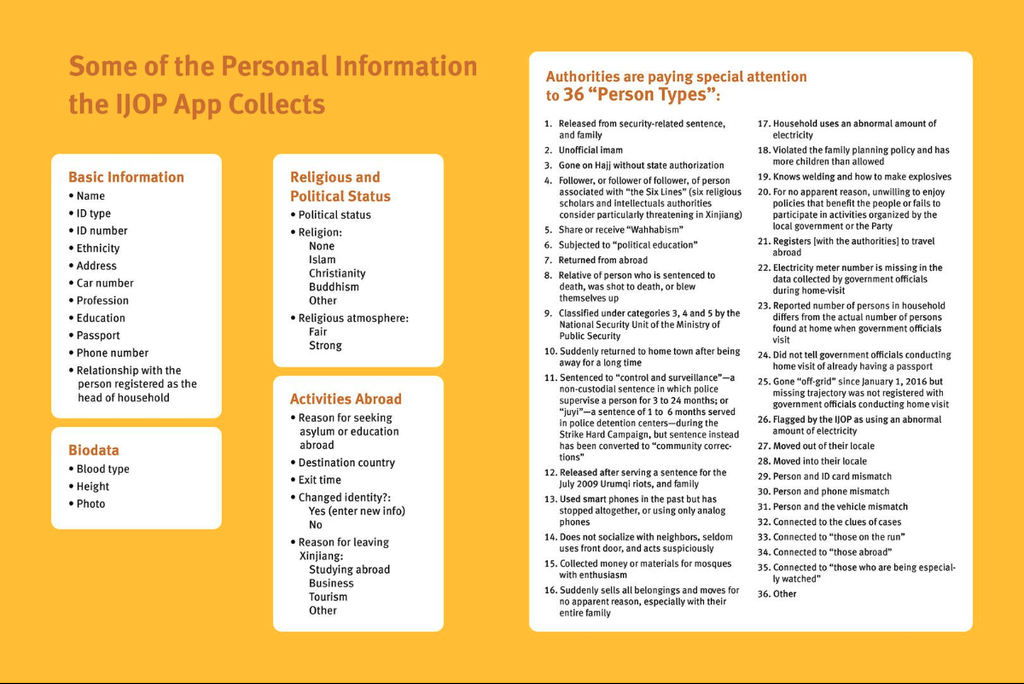
One of IJOP’s defining features is its 36 “person types” classification system. The categories illustrate how ordinary aspects of Uyghur religious and social life are transformed into indicators of security risk. They include participation in unauthorized Hajj pilgrimage, serving as an unofficial imam, going “off-grid” within the surveillance system, discontinuing smartphone use, unusual electricity consumption, or failing to socialize with neighbors. None of these behaviors constitute criminal offenses. IJOP interprets ordinary religious practice, daily routines, and social interactions like these as predictive indicators of extremism.
Companies Facilitating the State Surveillance
Understanding how China’s surveillance architecture operates and identifying the state agencies, technology firms, and component suppliers that sustain it is essential for accountability. Focusing on individual software applications alone risks obscuring the broader ecosystem that enables digital repression. Examining these systems together demonstrates how surveillance technologies, corporate actors, and public security institutions work together to translate ordinary activities into sources of actionable intelligence for policing, repression, and state control.
The surveillance systems examined in this report reflect a broader ecosystem of state-owned defense contractors, private technology firms, publicly listed companies, and component suppliers that collectively sustain China’s digital surveillance infrastructure in East Turkestan. At the center of this ecosystem is China Electronics Technology Group Corporation (CETC), one of China’s largest state-owned defense conglomerates. Through its subsidiary Hebei Far East Communication System Engineering (HBFE, 河北远东通信系统工程有限公司), CETC developed the Integrated Joint Operations Platform (IJOP), while another wholly owned affiliate, Xinjiang Lianhai Chuangzhi (新疆联海创智信息科技有限公司,developed the Xinjiang Public Security Micro-Police platform. Together, these systems link govenment services with predictive policing and intelligence analysis.
Private firms also play a significant role. Shanghai Landasoft Data Technology (上海蓝灯数据公司) developed both iTap, the intelligence analysis platform, and Clean Net Guard, the mobile phone inspection application. According to company materials, Landasoft’s analytical products derive from the i2 analytical model originally developed in the United Kingdom and acquired by IBM in 2011. Foundation Work Assistant was co-developed by the XUAR Public Security Department and Beijing Hi-Target Navigation Technology (北京合众思壮科技股份有限公司), a Zhenzhen Stock Exchange listed company specializing in GNSS and BeiDou positioning technologies. With Landasoft and Hi-Target, CETC links China’s defense industrial communications sector directly to the digital surveillance infrastructure used to identify, classify, and target Uyghur and other Turkic peoples.
A second tier of companies supply the underlying technologies embedded within these platforms. Facial recognition capabilities are provided by companies including SenseTime, SenseNets, Megvii Face++, and Intellifusion. SenseNets, a Shenzhen based subsidiary of SenseTime, drew international scrutiny in 2019 after an unsecured database exposed the personal records of more than 2.6 million residents of East Turkestan, illustrating both the scale of surveillance data being collected and the risks associated with its management.
Hikvision and NetPosa Technologies (东方网力科技有限公司) provide surveillance camera infrastructure and related security technologies, while iFlytek supplies voice recognition capabilities reportedly used across much of China’s public security system. The American company Thermo Fisher Scientific supplied the DNA sequencers used by public security bureaus for biometric collection in East Turkestan. IJOP also incorporates technologies including the AcroPhone/AcroUC unified communication platform, Baidu Maps for officer geolocation, as well as wireless network sniffers and checkpoint hardware that feed data into the broader surveillance network.
These suppliers span state-owned defense contractors, privately listed Chinese technology firms, and at least one American company. Together, they illustrate that the surveillance apparatus depends not on a single developer or platform but on an extensive ecosystem of commercial technologies that support every state of the surveillance process, from biometric collection and household registration to intelligence analysis and predictive policing.
Conclusion
iTap and IJOP illustrate how China’s surveillance apparatus extends beyond data collection. Foundation Work Assistant, Xinjiang Public Security Micro-Police, and Clean Net Guard generate continuous streams of household, biometric, identity and behavioral, and device data. iTap integrates and analyzes those records while IJOP translates analytical outputs into operational policing decisions. Every subsequent police interaction, whether a household inspection, checkpoint stop, phone search, or interrogation, generates additional information that feeds back into the system, continuously updating profiles, refining risk assessments, and directing future policing.
Information collected at checkpoints, through mobile phone, during household visits, and routine interactions with government services can determine who is questioned, whose home is searched, whose relatives are contacted, and who is detained. The system transforms ordinary activities into indicators of suspicion and embeds policing and with it fear within the routine administration of Uyghur society. Surveillance in East Turkestan forms part of the administrative infrastructure through which detention, coercive assimilation, and social control are organized, automated, and continuously reproduced.
Acknowledgement: Uyghur Rights Monitor appreciates support from the Center for Advanced Defense Studies (C4ADS) for this research.
Appendix: Platform Information
The tables below provide a consolidated reference of the five surveillance platforms examined in this report, summarizing each platform’s developer, intended users, documented functions, operational workflow, and known data fields based on the open source materials described in the methodology section.
Table A1. Foundation Work Assistant at a glance
| Developers | XUAR Public Security Department + Beijing Hi-Target Navigation Tech Co., Ltd. (北京合众思壮; Shenzhen Stock Exchange-listed); copyright dated 2017 |
| Stated policing doctrines operationalized | “Not missing one household, not missing one room, not missing one person” (不漏一户、不漏一屋、不漏一人); “person comes, register, person leaves, cancel” (人来登记,人走注销) |
| Users | Community police (社区民警); auxiliary police (辅警/协警); grid workers (网格员); “Fanghuiju” (访惠聚) work-team cadres dispatched to live in XUAR residents’ homes; prefecture- and county-level “Fanghuiju” back-office staff (via supervisor dashboard) |
| Core functions | Floating-population registration and cancellation; door-to-door visit logging; precise GPS coordinate capture per submission; QR-code-based house-address lookup; on-site photo upload; work-task assignment and receipt; daily work-log filing from the field; back-office “remote zero-distance supervision” (远程零距离督促) dashboard |
| Data captured | Identity and biographical data on every non-locally-registered occupant; high-precision GPS coordinates of each submission (and of the supervising officer); registered house-address data retrieved by QR-code scan; on-site photographs; work-team activity metrics (visit timestamps, frequency, per-officer productivity); movement and turnover data at per-dwelling level; explicit flags on persons with prior records, “no proper occupation” (无正当职业), or evasion of registration |
| Operational workflow | (1) Task pushed to officer or cadre (e.g., canvass a rental block, work-site dormitory, or guest-house cluster); (2) Officer arrives at dwelling, GPS coordinates logged; (3) QR-code scan retrieves registered address; (4) Door-to-door interview under “不漏一户” doctrine, identifying all occupants and recording data on any non-locally-registered person; (5) Records submitted with photos; auto-validation flags missing fields; (6) Daily work log filed before officer leaves field; (7) In border or cross-jurisdiction cases, data pushed to neighboring stations via the police comprehensive platform (警综平台) under the “two-ended capture, two-directional management” (两头抓、双向管) framework; (8) Prefecture/county back-office monitors team activity via supervisor dashboard; audit cycles of daily checks, weekly samples, and monthly reports verify data quality |
Table A2. Xinjiang Public Security Micro-Police at a glance
| Developer | Xinjiang Lianhai Chungzhi (新疆联海创智), wholly owned affiliate of CETC |
| Users | Citizens and Enterprises (Excluding XPCC residents) |
| Service offering 89 items in 4 categories | • 66 public security items (治安): 59 household-registration, 4 floating-population, 2 ID-card, 1 temporary-ID • 13 traffic-management items (6 vehicle, 6 driver’s-license, 1 traffic-violation query) • 9 enterprise-related items • 1 border-management item (online appointment for border-zone permit, initially Urumqi residents only) |
| Electronic certificates (亮证), 6 categories, recognized in 47 use scenarios | Resident identification card; household-registration booklet; driver’s license; vehicle license; residence permit; temporary residence-registration certificate. Use scenarios include hotel check-in, postal counters, vehicle checks, and the handling of business matters |
| Data collected | Identity data (name, citizen ID number, ID-card photograph, household-registration record); driving and vehicle data; residence data; border-zone travel data; enterprise-registration data; biometric data, facial recognition captured at registration and on every electronic-certificate display; behavioral and transactional data; cumulative electronic-certificate display data; correspondence data via the three-tier director’s mailboxes |
| Reported usage (since July 2022) | Approximately 23.6 million user visits; 3.98 million completed transactions; 2,353,800+ cumulative electronic-certificate display events |
| Integration | User system shared with the Xinjiang Government Affairs Platform, producing single sign-on across police-line modules and other government agencies. Underlying records draw from the broader 公安大数据 (public security big data) infrastructure |
| Operational steps for a resident | (1) Open WeChat, enter mini-program; (2) Complete one-time real-name registration via shared Government Affairs Platform user system; (3) Receive automatic generation of personal electronic certificates from existing public security records; (4a) For service items: submit request, receive result electronically or by mail; (4b) For certificate use (亮证): log in, select certificate, pass facial-recognition verification, display certificate with single-use QR code (screenshots are not reusable) |
Table A3. Clean Net Guard at a glance
| Developers | Shanghai Landasoft Data Technology |
| Users | General citizens, publicly distributed Android application |
| Device identifier extraction | IMEI number; MAC address; device manufacturer and model; telephone number; IMSI (International Mobile Subscriber Identity); line number |
| File-system scanning | Recursive scan of external storage; per-file capture of file name, file path, file size, MD5 of contents, and MD5 hash of that hash; matching against a remote-server blacklist of file signatures |
| Screenshot function | On finding flagged files and user action, captures screenshot of flagged file list, saves it to external storage root in a timestamped image format, exports it to the device’s gallery , then deletes the original from the storage root. |
| Data Transmission | The app sends the information it collects to a fixed server address built into the app: bxaq.landaitap.com. The name of this server includes “landaitap,” which links the app’s back-end infrastructure to Landasoft’s iTap product line. |
Table A4. iTap at a glance
| Developer | Shanghai Landasoft Data Technology (上海蓝灯数据) privately held; product line derived from i2 (Cambridge, UK, 1990; acquired by IBM 2011) |
| Users (three tiers) | (1) Leadership level: situational awareness, rapid deployment; (2) Front line officers: instant analytical results; (3) Specialized police units across criminal investigation (刑侦), economic-crime investigation (经侦), counter-terrorism (反恐), public-order (治安), intelligence (情报), drug enforcement (缉毒) |
| Core Analytical Function | One-click identity verification (一键核查); graphical identity research(recovery of real identity behind aliases and virtual IDs); relationship-circle mining via co-presence analysis across hotels, internet cafes, civil aviation, railways, vehicles, and mobile phones; tactical creation (战法) via graphical configuration without coding; historical traceback to identify previously unknown “orange tier” persons of interest |
| Data scale | Approximately 54 million “high risk persons” indexed in specialized topical datasets including drug, theft, fraud, gambling related populations, and “stability related persons” (涉稳关系人员信息); approximately 30 billion trajectory records drawn from public security and social data across 10+ Chinese provinces |
| Data fields aggregated | ID card numbers; telephone numbers; IMEI handset code; license plates; virtual/online identifiers; hotel registrations; internet café logins; civil aviation and railway record; vehicle movement records; mobile phone locations; case data; suspect data; entry/exit records; permanent and temporary residence records; same household, co-travel, and communication contacts |
| Cross-jurisdictional feature | “Tactical Alliance” (战法联盟), city-to-city sharing model for tactics, case data, high-risk-population data, trajectory data, and internet resources |
| Documented operational use in Xinjiang | Applied by Xinjiang public security authorities in the investigation of the 28 October 2013 Tiananmen Square vehicle attack |
Table A5. IJOP at a glance
| Developer | Hebei Far-East Communication System Engineering (HBFEC), subsidiary of CETC, state-owned |
| Users | Community police, auxiliary police, and other authorized frontline personnel |
| Personal data fields collected | Height; blood type; political affiliation (whether a member of the Chinese Communist Party); religious and political status; activity abroad; vehicle and bank information; family member details; phone and software information, all linked to the subject’s national identification number |
| Auxiliary data ingested by the central platform | Closed circuit television networks (including cameras with facial recognition and infrared capability); Wi-Fi sniffers; vehicular checkpoints; visitor management systems; package delivery records; real name gas station systems; base station and cell site information; other Xinjiang government data collection applications |
| Component technologies | AcroPhone/AcroUC (unified communications); Face++ (facial-recognition comparison); Baidu Maps (geolocation, officer location logging); Wi-Fi network detection capturing SSIDs, encryption methods, and coordinates (“war driving” pattern per HRW) |
| Targeting mechanism, 36 categories of “person types” (人员类型) | Indicators include unauthorized Hajj pilgrimage; status as unofficial imam; persons “off grid” of the surveillance infrastructure; those who stopped using a smartphone; abnormal electricity consumption; failure to socialize with neighbors; unexpected movement; person phone, person vehicle, or person identification mismatches. |
| Operational workflow | (1) Officers feed personal data records into the platform from home visits, street stops, political education facilities, and travel abroad registration points; (2) Ancillary infrastructure (CCTV, Wi-Fi sniffers, checkpoints, etc.) feeds in parallel; (3) System joins records to identity via national ID number (4) System searches for “micro-clues” matching the 36 categories; (5) Real time predictive warnings are pushed to officers and checkpoints; (6) Officers conduct follow up surveillance: home visits, questioning of relatives, vehicle inspection, device inspection, bank and family data logging. |
36 “Person Types”