
Ablet Turdi and Erk Altay
A language can disappear from public life without formally being banned. It can be removed from classrooms, displaced from government offices, diminished on public signs, and progressively excluded from the institutions through which people communicate, create, and learn. Over time, these changes can confine a language once central to a society to increasingly narrow spaces, threatening its transmission to future generations. This is the danger confronting the Uyghur language in occupied East Turkestan.
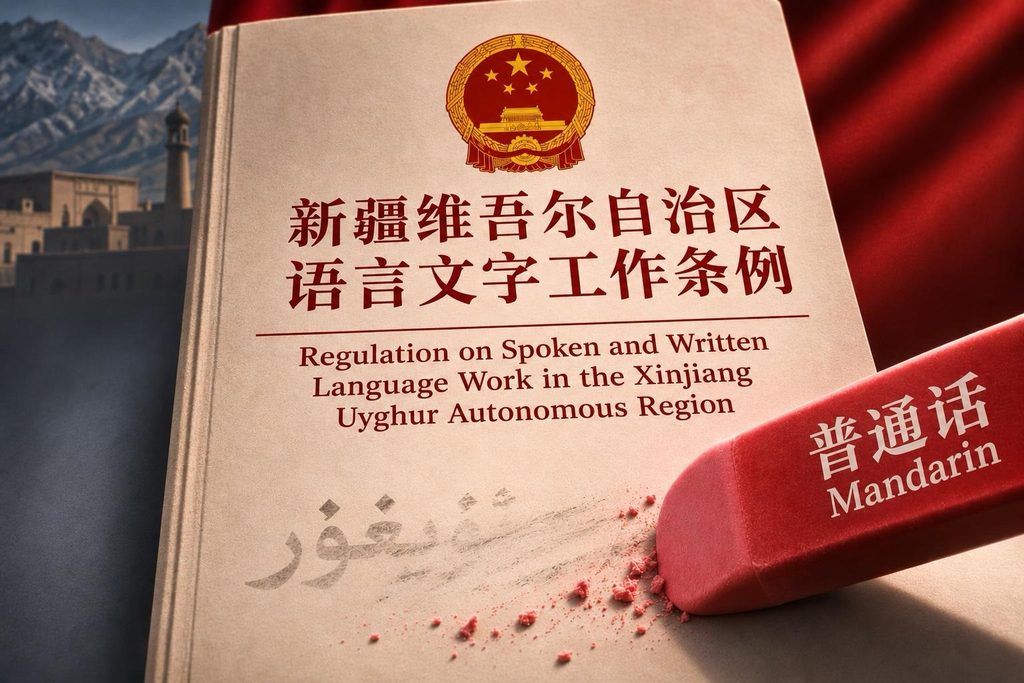
On September 23, 2026, the Standing Committee of the Xinjiang People’s Congress adopted a revised Regulation on Spoken and Written Language Work, scheduled to take effect on January 1, 2027. The regulation does not explicitly ban Uyghur. Indeed, it no longer mentions Uyghur by name in its operative provisions, although the previous version expressly recognized it. Instead, it retains general assurances protecting ethnic minority languages while establishing the primacy of the national common spoken and written language Putonghua, or standard Mandarin, and standardized Chinese characters across public administration, education, commerce, media, and other areas of social life (Articles 1-3, 12-20).
The regulation also mobilizes government institutions, businesses, and social organizations to promote Mandarin while imposing political and administrative requirements on minority language translation and cultural production (Articles 12-24). These changes form part of a broader transformation of China’s governance in East Turkestan. Viewed through a colonial framework, they reveal how the Chinese state is reorganizing the institutions that once sustained Uyghur identity around a state-defined, Han-centric Chinese national identity. In this process, Uyghurs and their language are increasingly minoritized in their own homeland, subordinated through laws and institutions that diminish the authority, utility, and public standing of their language.
These provisions are inconsistent with the China’s own Constitution which guarantees all minority nationalities “the freedom to use and develop their own spoken and written languages” (Article 4). The danger is not simply that Uyghurs must learn Mandarin, but that the institutions necessary for Uyghur to remain a language of education, public participation, cultural production, and collective memory are being restructured around a dominant national language and identity that further marginalizes the Uyghur language amid China’s ongoing repression of Uyghurs.
From linguistic equality to legal subordination
The revised regulation fundamentally restructures language governance in East Turkestan by legally entrenching the primary of Mandarin Chinese and marginalizing the Uyghur language. It is a significant departure from the original regulatory framework, adopted in 1993 and amended in 2002, which emphasized linguistic equality, Uyghur language development, and bilingual public administration. The 2015 revision, although already promoting Mandarin, retained explicit guarantees of linguistic equality. It’s Article 2 required authorities to uphold equality among ethnic languages and protect the freedom to use and develop them. Article 8 specifically named Uyghur, alongside Mandarin, required regional authorities to use both in official business and recognized their equal legal effect.
The 2026 revision removes these express guarantees and codifies existing policies and practices of forced assimilation and linguistic erasure of Uyghurs. Article 1 of the latest revision establishes the objective of safeguarding the principal position of the national common language, Mandarin. Article 12 makes Mandarin the language of official business while allowing state institutions to use locally common minority languages according to official needs.
The revision also omits earlier provisions protecting minority language use in legal proceedings, government communications, examinations, and other administrative interactions. Although higher ranking national legislation continues to provide certain language protections, the regional regulation no longer expressly guarantees them.
The shift is equally visible in public space. The 2015 regulation required simultaneous use of the Mandarin and minority languages on specified official and public materials (Article 11). The revised regulation instead requires Mandarin to occupy a larger proportion of bilingual displays and receive preferential placement above or beside Uyghur if and when Uyghur is displayed (Article 20).
Making linguistic assimilation a civic responsibility
The revised regulation distributes responsibility for Mandarin promotion across government institutions and organized social life. It declares promotion of Mandarin a responsibility of society as a whole, extending obligations to state organs, enterprises, public institutions, and social organizations (Article 4). It also establishes Party leadership, government coordination, dedicated funding, and sectoral oversight, assigning responsibilities to authorities overseeing education, publishing, broadcasting, commerce, transportation, public security, and other fields (Articles 6-9). Furthermore, the revised regulation requires businesses, organizations, and public service personnel to serve as examples in learning and using the national common language and to proactively communicate in Mandarin in public settings (Article 12).
These obligations matter because linguistic choices are shaped by institutions. As Pierre Bourdieu (1991) puts it, linguistic competence functions as a form of capital whose value depends on the social and institutional settings in which it is recognized. James Tollefson (1991) similarly explains how language policies can reproduce structural inequalities by regulating access to institutions and opportunities. In the Uyghur context, Arienne Dwyer (2005) documents how Chinese language policies have historically subordinated Uyghur through changes in education, publishing, and public life.
The revised regulation strengthens these mechanisms by making Mandarin promotion an institutional obligation across society. As Mandarin becomes increasingly necessary for education, employment, commerce, and public services, opportunities to operate in Uyghur shrink.
The revised regulation also organizes and supervises language promotion. It mandates regular publicity activities, including a national common language promotion week and outreach to rural communities (Article 23) and permits organizations and individuals to report noncompliant language use, requiring competent authorities to handle complaints within 15 working days (Article 10). It further provides commendations and rewards for outstanding contributions to language work (Article 11). Although the 2015 version of the regulation already contained supervisory and recognition mechanisms, the revision places them within a more explicit framework of Mandarin primacy.
Together, these provisions create overlapping obligations, administrative oversight, and incentives that encourage public and private institutions to prioritize Mandarin. The Uyghur language consequently loses institutional standing and may lose practical utility.
The reported removal of Uyghur commercial signs illustrates the broader process. In March 2026, Uyghur Times reported reviewing videos of municipal workers removing Uyghur signage from businesses in Ürümchi and Kashgar. These incidents preceded the revised regional regulation. Nevertheless, they reflect a troubling trajectory in which Uyghur’s visibility in public and commercial spaces diminishes as Mandarin gains institutional priority.
Controlling the production of language and culture
The regulation’s implications extend beyond everyday communication to the creation and dissemination of Uyghur literature, news, entertainment, scholarship, and digital content. Language vitality depends not only on the number of speakers but also on intergenerational transmission and sustained opportunities for use across social and cultural domains (Fishman, 1991). Newspapers, literature, textbooks, films, and digital media enable speakers to develop linguistic competence, produce knowledge, and sustain cultural expression. Research on minority language media emphasizes functional completeness, a language’s ability to meet its speakers’ diverse communication needs (Moring, 2007).
The 2015 version of the regulation expressly supported minority language education, publishing, cultural production, and technological development. It ensured protection for Uyghur language use in scholarly and artistic work (Article 19) and promoted minority language research, dictionaries, information processing, and digital applications (Article 35).
The 2026 revision changed these priorities. Article 14 of the revised regulation establishes Mandarin as the basic language of radio, film, television, and online audiovisual programming, including digital entertainment. Approved minority language productions must include subtitles in Mandarin. Article 15 regulates publications, including books, newspapers, audiovisual products, and online games, while requiring minority language publications to comply with applicable language and publishing rules.
These provisions do not expressly ban Uyghur language publications or entertainment. Rather, they establish Mandarin as the institutional default in major media sectors while subjecting Uyghur language production to further regulatory conditions.
The digital implications are particularly significant. Article 19 regulates language use in government operated and public service digital platforms, while Article 26 emphasizes digital Chinese development, including applications involving artificial intelligence. Unlike the 2015 version of the regulation, which expressly promoted minority language information processing and its broader applications, the revised provision foregrounds Chinese language technological development.
Research suggests that exclusion from digital environments can threaten language vitality. András Kornai (2013) identifies digital marginalization as a serious risk for threatened languages, while Joshi et al. (2020) document stark inequalities in computational resources across languages. Lu et al. (2025) likewise identify resource limitations affecting Uyghur language AI development. With the prioritization of Chinese digital development in East Turkestan, these disparities could deepen, restricting access to digital education, information, and cultural production.
The regulation also tightens political supervision over translation and terminology. Article 24 requires minority language translations to adhere to the correct political orientation and display distinct Chinese characteristics. It directs translators to prioritize borrowing from Mandarin where equivalent minority language terminology is absent or deemed insufficiently precise. Article 25 provides for official standardization of terminology and extends political orientation requirements to translation software.
Translation and terminology are not politically neutral. They shape how historical experiences, political ideas, and cultural knowledge are communicated. Scholars of translation and colonial power have examined how dominant institutions influence knowledge through linguistic representation (Niranjana, 1992; Baker, 2006). The revised regulation therefore raises concerns about the Chinese state’s growing authority over the development of Uyghur terminology and the production of knowledge in Uyghur. These provisions would in effect contribute to further colonization of the Uyghur language.
Article 27 compounds these concerns by directing governments to support literary and artistic works grounded in Chinese culture and reflecting ethnic unity, progress, and integration. Although it does not explicitly prohibit other works, it identifies the forms of cultural expression that should be prioritized.
These provisions operate against a longstanding record of repression targeting Uyghur intellectual and cultural life. As early as 2002, Human Rights Watch documented reports of authorities destroying Uyghur language books concerning literature, history, and culture. Subsequent campaigns targeted not only publications but also their authors, editors and translators.
Radio Free Asia reported in 2024 that publisher Erkin Emet had been imprisoned in connection with books addressing Uyghur history and identity. Uyghur literary critic and textbook editor Yalqun Rozi received a 15-year prison sentence in 2025 for “inciting subversion of state power” in his work on Uyghur language educational materials. PEN America has also documented the detention of Abliz Ömer, a former editor-in-chief at Kashgar Publishing House. Dilmurat Mahmut and Joanne Smith Finley (2026) examine the rewriting of Uyghur literature textbooks following the campaign against their editors, placing these changes within a broader process of cultural assimilation.
The crackdown extends to music. A 2025 Associated Press investigation documented bans on Uyghur songs, including traditional folk music, religiously themed works, and songs expressing Uyghur identity. Authorities reportedly threatened detention for listening to, storing, or sharing prohibited recordings. Musician Yashar Shohret received a three-year prison sentence for offenses reportedly involving his music and possession of Uyghur language books; Amnesty International confirmed his release in August 2026.
These cases demonstrate how authorities have targeted not only Uyghur language expression but also the histories, identities, and memories conveyed through it. The revised regulation enters this restrictive environment with additional political requirements for translation and terminology. While the repression of writers, editors, publishers, and musicians weakens Uyghur cultural production, the regulatory framework further concentrates state authority over how Uyghur knowledge is produced, standardized, and circulated.
From public displacement to private language loss
The consequences may eventually extend further into the private spaces where Uyghur remains most resilient. Policies that distinguish official language use from private communication overlook the relationship between the two. Public institutions shape which languages children encounter, develop, and continue using within inside and outside their homes.
Children acquire languages through more than family interaction. Schools, peers, community institutions, literature, and media provide essential opportunities for exposure and practice. Research on childhood bilingualism demonstrates that minority language acquisition depends on linguistic input, literacy, language status, and community support (Pearson, 2007). Removing a language from major social domains reduces opportunities to develop and sustain it, potentially accelerating intergenerational language loss.
Education is especially consequential. Unlike the 2015 regulation, which expressly required parallel instruction in the national common and minority languages within bilingual education, the revised text contains no equivalent provision. The 2026 revision establishes Mandarin as the basic language of instruction, requires nationally compiled textbooks in accordance with national provisions, and promotes Putonghua education from preschool (Article 13). It also reinforces these requirements through professional proficiency standards and vocational, distance, and adult education (Articles 21 and 22).
Children may speak Uyghur at home while acquiring academic, scientific, and professional vocabulary primarily in Mandarin. Over time, they may find it easier to discuss complex subjects in Mandarin, even if Uyghur remains their emotional and cultural mother tongue. The result can be a growing divide between conversational fluency and literacy.
Education and employment reinforce these pressures. As Mandarin becomes increasingly necessary for qualifications, professional advancement, public services, and digital participation, parents may prioritize it to improve their children’s opportunities. Yet when Uyghur language educational and cultural resources simultaneously decline, these choices reflect unequal institutional conditions rather than linguistic preference.
The state’s broader ethnic unity legislation also raises concerns about language and cultural transmission within families. Article 20 of the China’s national Law on Promoting Ethnic Unity and Progress, effective July 1, 2026, imposes responsibilities on parents and guardians concerning loyalty to the Communist Party, the state, and the Chinese nation. In an April 2026 communication, UN human rights experts questioned whether the law’s broad provisions might restrict minority language education and the transmission of cultural and religious traditions within families.
UNESCO’s language vitality framework identifies intergenerational transmission, domains of use, educational materials, and participation in new media as essential indicators of a language’s long-term viability. A language’s survival cannot therefore be assessed solely by counting its speakers. The danger is not simply that Uyghur might disappear from public institutions, but that its minoritization in those institutions could eventually undermine its use and transmission among Uyghurs.
Colonial governance through the remaking of language
The revised regulation must also be situated within the colonial transformation of East Turkestan. Its colonial dimension lies not simply in the promotion of another language, but in the colonization of the language itself and the redistribution of authority over the institutions through which a people reproduce their identity.
Minoritization is not merely a demographic condition but a political and institutional process through which the languages and cultural institutions of historically rooted communities are subordinated within unequal structures of power (Stephen May, 2012). In East Turkestan, Mandarin dominant institutions redistribute educational and professional opportunities, reshape cultural production, and influence how younger generations understand their identity and belonging.
Scholarship on Uyghur society has examined these processes through colonial and settler-colonial frameworks. Joanne Smith Finley (2022) analyzes the restructuring of Uyghur cultural life, while Timothy Grose (2020) documents state interventions into Uyghur domestic spaces and cultural practices. Research by M. A. and Darren Byler (2022) examines how educational institutions devalue Uyghur knowledge and constrain students’ sense of belonging.
These studies shift the analytical question beyond whether Mandarin proficiency offers practical advantages. The deeper issue is who determines the terms of participation, which forms of cultural knowledge retain public value, and whether Uyghurs have meaningful authority over the institutions that once sustained and increasingly marginalize their language.
The revised regulation explicitly ties language policy to a broader project of national identity formation. The regulation follows the adoption of the national Law on Promoting Ethnic Unity and Progress, which places Chinese national identity and Mandarin at the center of ethnic governance. Article 1 of the revised regional language work regulation identifies forging a strong sense of community for the Chinese nation as a legislative objective, while Article 5 links language use to national unity, socialist values, and constructing a shared spiritual home for the Chinese nation.
China presents these policies as instruments of educational opportunity, development, and national cohesion. Viewed through a colonial framework, the revised regulation reorganizes linguistic and cultural authority in East Turkestan, making participation in public life increasingly dependent on the language and identity promoted by the Chinese state. As Uyghur institutions are reoriented toward reproducing a state-defined Chinese national community, Uyghurs and their language face further minoritization within their own homeland.
International law implications
China’s language policy also raises questions under its domestic legal guarantees and international human rights obligations however hollow they may be. Article 4 of China’s Constitution protects the freedom of ethnic groups to use and develop their languages. The Law on Regional Ethnic Autonomy provides related protections under Articles 10, 21, and 37, including provisions concerning minority language use in autonomous administration and education.
China is a party to the International Convention on the Elimination of All Forms of Racial Discrimination (ICERD), the International Covenant on Economic, Social and Cultural Rights (ICESCR), and the Convention on the Rights of the Child (CRC). Under ICERD, Articles 2 and 5 require states to address racial and ethnic discrimination, including in education and cultural participation.
The ICESCR protects education and cultural participation under Articles 13 and 15. In General Comment No. 21, the Committee on Economic, Social and Cultural Rights emphasizes the importance of protecting minority cultural identities and access to education and cultural expression. In its 2023 concluding observations on China, the Committee expressed concern about restrictions on minority language education and reported school closures affecting Uyghur, Tibetan, and Kazakh language instruction. It recommended that Mandarin not be the only permitted language of instruction for ethnic minorities. China contested these findings, maintaining during the review that minority region schools provided bilingual education and rejecting certain criticisms concerning East Turkestan and Tibet in its subsequent written comments.
The CRC is especially relevant to intergenerational transmission. Article 29 requires education to foster respect for children’s cultural identities and languages, while Article 30 protects minority children’s right to use their own language. In its 2013 concluding observations, the Committee called for effective bilingual education, promotion of minority languages, and Uyghur and Tibetan children’s participation in educational decisionmaking. Its October 2026 list of issues renewed scrutiny of minority language education and China’s ethnic unity legislation.
China’s responses during its 2024 Universal Periodic Review further illustrate its approach to international scrutiny. Beijing rejected Austria’s recommendation concerning forced cultural, religious, and linguistic assimilation of Uyghurs and Tibetans, as well as Denmark’s recommendation concerning minority language rights and Tibetan residential schooling, dismissing them as based on false information. By contrast, it accepted Cuba’s recommendation to strengthen standard spoken and written Chinese in minority areas.
A language pushed further to the margins
The 2026 revision consolidates a process already underway. Mandarin promotion and restrictions on Uyghur education, publishing, and cultural expression long predate the legislation. What the revision adds is a clearer legal hierarchy, broader institutional obligations to promote Mandarin, and greater political control over the conditions in which Uyghur and other Turkic languages are used and developed in East Turkestan.
The consequences will likely accumulate across generations. Mandarin centered education will likely further weaken advanced Uyghur literacy. Reduced opportunities for publishing, broadcasting, and digital production will likely diminish the materials needed to sustain it. The marginalization of Uyghur in government, commerce, employment, and public services will likely reduce its utility beyond the household, eventually reshaping family language practices and intergenerational transmission.
A child who learns Mandarin in preschool, studies primarily through Mandarin, consumes predominantly Mandarin language media, and enters Mandarin dominant workplaces may grow up with fewer opportunities to use Uyghur. Even where children continue speaking Uyghur at home, they may lack the educational and cultural resources necessary to develop it as a language of intellectual and professional life.
The risk of Uyghur’s nearly complete displacement from formal public institutions warrants urgent attention. With the implementation of the revised regulation on language, Uyghur society may become further disconnected from the Uyghur language. And if they do inherit it, future generations may inherit a language they can speak but can no longer meaningfully use to study, work, publish, govern, or participate in the intellectual life of their own society.
Table 1. Towards Mandarin Primacy: Key Changes in the XUAR Regulations on Spoken and Written Language Work, 2015–2026
| Issue | 2015 Regulation | 2026 Regulation |
| Basic legal principle | Article 2 expressly required language policy to follow the “principle of equality among the languages of all ethnic groups” and guaranteed all ethnic groups freedom to use and develop their own languages. | Articles 1 and 3 instead establish protection of the “principal position” of Mandarin, require its comprehensive promotion and refer to minority languages through “scientific protection” and safeguarding their learning and use. |
| Uyghur in regional government | Article 8 specifically required autonomous regional authorities to simultaneously use Mandarin and Uyghur when performing official duties. | Article 12 makes Mandarin the language of official business. State organs may simultaneously use locally common minority languages where official needs require. Uyghur is not specifically named. |
| Legal effect of languages | Article 8 expressly stated that minority languages and Mandarin had equal legal effect in the performance of official duties. | No equivalent provision appears in the revised regulation. |
| Public signs and commercial space | Article 11 required specified government materials, public signs, advertisements, notices, facilities and product information to simultaneously use Mandarin and minority languages. | Articles 16–20 make Mandarin the basic language of public services, signs and commercial materials. Where both languages are used, Article 20 requires the national language to occupy a larger proportion and preferential position. |
| Education | Articles 23–26 promoted bilingual education, required national and minority language instruction to proceed in parallel in preschool and primary/secondary bilingual education and contemplated both minority students attending Chinese language schools and Han students attending minority language schools. | Article 13 designates Mandarin as the basic language of education and instruction, requires nationally unified textbooks, strengthens Putonghua education beginning in preschool and integrates national language education throughout curricula, teaching, management and assessment. |
| Mutual language learning | Article 22 expressly encouraged mutual learning: Han citizens should actively learn local minority languages, while minority citizens should learn the national common language alongside their own. | The revised regulation repeatedly assigns institutions and citizens responsibilities to learn and promote Mandarin, including through vocational training, night schools and public campaigns. It contains no comparable duty encouraging Han citizens to learn local minority languages. |
| Public service | Article 27 required transportation, health, taxation, public security, commercial, postal, telecommunications and financial services to give staff bilingual training so they could serve citizens in locally used languages. | Articles 12 and 22 require public service personnel to model use of Mandarin and expand national language training across public services and industry. |
| Courts, petitions and administrative interactions | Articles 15–17 expressly protected language choice in examinations and recruitment, the right to use one’s own ethnic language in litigation and the right to communicate with government authorities in a language the citizen understands, with translation where necessary. | The 2026 regulation contains no corresponding provisions addressing these settings. |
| Minority language culture and media | Articles 18–19 required governments to promote minority language education, science, culture, publishing, broadcasting, film, online content and related activities and to protect minority researchers and artists using their own languages. | Articles 14–15 designate Mandarin as the basic language of broadcasting, film, online audiovisual programming and publishing. Approved minority language audiovisual works must carry national language subtitles. Article 27 supports cultural production in either language when rooted in “Chinese culture” and reflecting ethnic unity and integration. |
| Translation and terminology | Articles 28–32 emphasized building minority language translation capacity, staffing translators, translating books and films and training minority language translators, editors, teachers and researchers. Article 35 provided for research and standardization of minority language terminology. | Article 24 requires minority language translation to follow the “correct political direction” and demonstrate “distinctive Chinese characteristics.” Where a minority language lacks or cannot “accurately express” a term, terminology should preferentially be borrowed from the national common language. Translation software is subject to the same political direction requirement. |
| Language research and technology | Article 35 specifically directed authorities to strengthen theoretical, applied and technological research on minority languages, including dictionaries, standardization, software processing and informatization. | Articles 19 and 26 emphasize the informatization, digitalization and intelligent development of the national common language and “digital Chinese,” including applications in information technology and AI. |
| Governance and implementation | Article 7 established a government-led mechanism involving competent departments and social participation. | Articles 4–9 explicitly establish Communist Party leadership, government direction, sectoral responsibility and whole-of-society participation. Enterprises, social organizations, government departments, townships and subdistrict offices receive affirmative Mandarin promotion responsibilities. |
Translation
Regulations of the Xinjiang Uygur Autonomous Region on Spoken and Written Language Work (2026)
The English text below is an AI-assisted translation checked against the original Chinese text, which is available here.
Adopted at the Fourth Meeting of the Standing Committee of the Eighth People’s Congress of the Xinjiang Uygur Autonomous Region on September 25, 1993; amended in accordance with the Decision on Amending the Regulations of the Xinjiang Uygur Autonomous Region on Spoken and Written Language Work, adopted at the Thirtieth Meeting of the Standing Committee of the Ninth People’s Congress of the Xinjiang Uygur Autonomous Region on September 20, 2002; revised for the first time at the Eighteenth Meeting of the Standing Committee of the Twelfth People’s Congress of the Xinjiang Uygur Autonomous Region on September 21, 2015; and revised for the second time at the Thirty-First Meeting of the Standing Committee of the Fourteenth People’s Congress of the Xinjiang Uygur Autonomous Region on September 23, 2026.
Announcement No. 94 of the Standing Committee of the Fourteenth People’s Congress of the Xinjiang Uygur Autonomous Region
The Regulations of the Xinjiang Uygur Autonomous Region on Spoken and Written Language Work were revised and adopted at the Thirty-First Meeting of the Standing Committee of the Fourteenth People’s Congress of the Xinjiang Uygur Autonomous Region on September 23, 2026. They are hereby promulgated and shall enter into force on January 1, 2027.
This announcement is hereby issued. Standing Committee of the People’s Congress of the Xinjiang Uygur Autonomous Region
September 23, 2026
Chapter I. General Provisions
Article 1. These Regulations are enacted in accordance with the Law of the People’s Republic of China on the National Common Spoken and Written Language and other relevant laws and administrative regulations, and in light of the actual circumstances of the autonomous region, in order to safeguard the principal position of the national common spoken and written language; advance the normalization, standardization, and sound development of spoken and written languages; promote the inheritance and development of fine Chinese language and culture; forge a strong sense of community for the Chinese nation; and advance the building of a community for the Chinese nation.
Article 2. These Regulations apply to the learning, use, translation, research, management, and supervision of the national common spoken and written language and ethnic minority spoken and written languages within the administrative territory of the autonomous region.
Article 3. The autonomous region shall comprehensively promote and popularize the national common spoken and written language, scientifically protect the spoken and written languages of all ethnic groups, and respect and safeguard the learning and use of ethnic minority spoken and written languages.
Article 4. Promoting and popularizing the national common spoken and written language is the common responsibility of society as a whole. State organs, social organizations, enterprises, public institutions, and other social organizations shall perform their responsibilities for promoting and popularizing the national common spoken and written language in accordance with law.
Learning and using the national common spoken and written language is a right of citizens. No organization or individual may obstruct or restrict citizens from learning and using the national common spoken and written language on grounds of ethnicity, religion, region, customs, or other such reasons.
Article 5. Spoken and written language work in the autonomous region shall uphold the leadership of the Communist Party of China, follow the laws governing the development of spoken and written languages, and be organically integrated with efforts to build a strong autonomous region in education, science and technology, culture, and talent development.
The use of spoken and written languages shall be conducive to safeguarding national sovereignty and national dignity; safeguarding national unity and ethnic unity; cultivating and promoting core socialist values; inheriting and developing fine Chinese culture and building a shared spiritual home for the Chinese nation; advancing socialist material and spiritual civilization; improving people’s livelihoods and rallying public support; and improving citizens’ overall competence and promoting their all-round development.
Article 6. Spoken and written language work in the autonomous region shall operate under a working mechanism characterized by Party committee leadership, government direction, overall coordination by departments responsible for spoken- and written-language work, fulfilment of responsibilities by the competent authorities of each sector, and participation by society as a whole.
Article 7. People’s governments at or above the county level shall incorporate spoken and written language work into national economic and social development plans; strengthen the promotion and popularization of the national common spoken and written language; implement education and instruction in the national common spoken and written language; manage the use of spoken and written languages in society; and include the necessary funding in their respective budgets.
People’s governments at all levels and their relevant departments shall strengthen the provision of necessary conditions for promoting and popularizing the national common spoken and written language in rural and remote areas, and provide support in policies, funding, personnel, and other respects.
Township people’s governments and subdistrict offices shall carry out publicity, education, and guidance concerning the promotion and popularization of the national common spoken and written language and the standardized use of spoken and written languages within their respective jurisdictions, thereby improving citizens’ awareness of and ability to use the national common spoken and written language.
Article 8. The department responsible for spoken and written language work in the autonomous region shall be responsible for planning, guidance, management, and supervision of such work.
Departments responsible for spoken and written language work and other relevant departments of people’s governments at or above the county level shall guide, manage, and supervise spoken and written language work within their respective administrative territories.
Article 9. Relevant departments of people’s governments at or above the county level, including those responsible for education, press and publication, radio and television, market regulation, housing and urban-rural development, culture and tourism, film, urban management, transportation, civil affairs, public security, cultural relics, cyberspace affairs, industry and information technology, ethnic affairs, judicial administration, human resources and social security, and health, shall, in accordance with their respective duties, promote and popularize the national common spoken and written language and manage and supervise the standardized use of spoken and written languages within their respective systems and sectors.
Article 10. Any organization or individual has the right to lodge a complaint or report with the relevant competent department concerning conduct that fails to comply with national or autonomous region norms and standards for the use of spoken and written languages.
Upon receiving a complaint or report, the relevant department shall handle the matter in accordance with law within fifteen working days and shall strictly maintain the confidentiality of relevant information concerning the organization or individual submitting the complaint or report, in accordance with law.
Article 11. Organizations and individuals that make outstanding achievements in spoken- and written-language work shall receive commendations and rewards in accordance with relevant national and autonomous region provisions.
Chapter II. Learning and Use of Spoken and Written Languages
Article 12. State organs shall use the national common spoken and written language as the language of official business. When performing their statutory duties, they may, according to official needs and in accordance with law, simultaneously use ethnic minority spoken and written languages commonly used in the locality.
Social organizations, enterprises, public institutions, other social organizations, and personnel working in public service sectors shall play an exemplary and leading role in learning and using the national common spoken and written language, proactively use Putonghua for communication in public settings, and foster an atmosphere in which society as a whole learns and uses the national common spoken and written language together.
Article 13. Schools and other educational institutions shall use the national common spoken and written language as the basic language of education and instruction. Schools and other educational institutions shall use nationally compiled textbooks in accordance with relevant national provisions.
The autonomous region shall strengthen Putonghua education for preschool children and promote their acquisition of Putonghua. Students shall be able to attain basic proficiency in the national common spoken and written language upon completing compulsory education.
In implementing the fundamental task of fostering virtue through education, schools of all levels and types shall comprehensively integrate education in the national common spoken and written language and education in fine Chinese language and culture into talent-development systems, including disciplines, academic specializations, courses, textbooks, instruction, administration, and evaluation.
Education administrative departments at or above the county level shall incorporate requirements for the standardized use of the national common spoken and written language into all aspects of school administration, teacher workforce development, student development, education and instruction, and assessment and evaluation. They shall improve teachers’ core competencies and teaching abilities in the national common spoken and written language and promote the integration of fine Chinese language and culture into the development of civilized campuses.
Article 14. Radio, film, television, and online audiovisual programmes, including online literary and artistic programmes, online dramas, and online films, shall use the national common spoken and written language as their basic language.
Films, television programmes, and online audiovisual programmes in ethnic minority spoken and written languages that have been approved for broadcast in accordance with law shall simultaneously provide subtitles in the national common spoken and written language, accurately and faithfully reflecting the principal content and core information of the works or programmes.
Article 15. Publications, including newspapers, periodicals, books, audiovisual products, and online games, shall use the national common spoken and written language in a standardized manner in accordance with national provisions.
All types of publications issued in ethnic minority spoken and written languages shall comply with relevant national and autonomous region provisions concerning spoken and written languages, publication administration, and related matters.
Article 16. Public service sectors shall use standardized Chinese characters as the basic written language for service provision.
Facilities in public places, as well as shop signs, advertisements, notices, signboards, publicity slogans, and similar materials, shall use the national common spoken and written language as their basic language. Where required by public service needs, ethnic minority spoken and written languages commonly used in the locality may be used simultaneously.
Article 17. The names, packaging, instructions, and other information concerning goods sold within the administrative territory of the autonomous region shall use the national common spoken and written language as their basic language.
Article 18. Market regulation departments of people’s governments at or above the county level shall, in accordance with law, manage and supervise the use of the national common spoken and written language and ethnic minority spoken and written languages in enterprise names, product names, packaging, instructions, advertisements, and other materials, ensuring that language use is standardized and accurate.
Article 19. The national common spoken and written language used in information-processing and information-technology products, as well as internet information platforms such as portal websites and mobile applications operated by governments or providing public services, shall comply with national norms and standards. Ethnic minority spoken and written languages used therein shall comply with relevant national and autonomous region provisions.
The autonomous region shall advance the informatization, digitalization, and intelligent development of the national common spoken and written language; expand its scenario-based applications in new fields, industries, and devices; and encourage and guide citizens to learn the national common spoken and written language through information technologies.
Article 20. The use of spoken and written languages shall be standardized and accurate and shall comply with laws, regulations, public order, and good morals.
Where it is necessary to use both the national common spoken and written language and ethnic minority spoken and written languages in public settings, including official activities, public services, and commercial services, the national common spoken and written language shall be given prominence in terms of position, sequence, and other aspects. The proportion occupied by the national common spoken and written language shall be greater than that occupied by ethnic minority spoken and written languages.
Where the languages are arranged one above the other, the national common spoken and written language shall appear above and the ethnic minority spoken and written language below.
Where the languages are arranged horizontally from left to right, the national common spoken and written language shall appear on the left and the ethnic minority spoken and written language on the right.
Where the languages are arranged in vertical columns from right to left, the national common spoken and written language shall appear on the right and the ethnic minority spoken and written language on the left.
Article 21. Personnel in positions where Putonghua is the working language shall possess the ability to speak Putonghua.
Announcers, programme hosts, film and television actors, stage actors, teachers, and personnel of state organs shall meet the Putonghua proficiency grade standards prescribed by the state. Those who have not yet met the prescribed standards shall receive training according to their circumstances.
Personnel engaged in translation, editing, and other related work for which ethnic minority spoken and written languages serve as working languages shall meet the Putonghua proficiency grade standards prescribed by the autonomous region and possess the corresponding ability to use ethnic minority spoken and written languages in a standardized manner.
Article 22. The autonomous region shall improve the ability of young and middle-aged workers to use the national common spoken and written language through vocational skills training, distance education, evening schools, and other means.
Relevant departments of people’s governments at or above the county level, including those responsible for market regulation, culture and tourism, transportation, industry and information technology, human resources and social security, agriculture and rural affairs, judicial administration, and health, as well as federations of trade unions, Communist Youth League organizations, women’s federations, and industry associations, shall strengthen education and training in the national common spoken and written language for personnel within their respective systems and sectors.
Article 23. The autonomous region shall regularly carry out publicity activities concerning the national common spoken and written language, develop innovative activities for the publicity week promoting and popularizing the national common spoken and written language, and organize thematic publicity activities concerning language and culture. It shall strengthen publicity and education concerning the national common spoken and written language in rural areas and communities and enhance society-wide awareness of its standardized use.
People’s governments at or above the county level shall conduct corresponding activities during the publicity week for promoting and popularizing the national common spoken and written language, fostering an atmosphere throughout society of learning and using the national common spoken and written language.
Chapter III. Translation and Research of Spoken and Written Languages
Article 24. Translation involving ethnic minority spoken and written languages shall adhere to the correct political orientation, demonstrate distinct Chinese characteristics, and ensure that translations are scientific, accurate, and standardized, thereby achieving development in step with the times and sound progress.
Where nouns or terms do not exist in ethnic minority spoken and written languages, or cannot be expressed precisely in those languages, priority shall be given to borrowing them from the national common spoken and written language.
Article 25. The autonomous region shall research, formulate, and improve relevant norms and standards for ethnic minority spoken and written languages and shall examine, approve, and publish standardized terms and terminology in those languages in accordance with laws and regulations.
Departments responsible for spoken and written language work and other relevant departments of people’s governments at or above the county level shall establish and improve mechanisms for managing translation involving ethnic minority spoken and written languages and strengthen the examination and approval of relevant language usage.
Standards governing the mutual transcription and translation of personal names, geographical names, and other terms between the national common spoken and written language and ethnic minority spoken and written languages shall comply with relevant national and autonomous region provisions.
Translations produced by spoken and written language translation software shall adhere to the correct political orientation, comply with relevant national and autonomous region laws, regulations, norms, and standards, and be scientific, accurate, and standardized.
Article 26. The autonomous region shall support higher education institutions and scientific research institutes in carrying out basic theoretical and applied research on spoken and written languages, promoting solutions to major theoretical and practical issues in language use and facilitating the application of language-related scientific research findings.
It shall support national and autonomous region institutions responsible for spoken- and written-language work in making use of their respective strengths to conduct comprehensive research, inheritance and promotion activities, education and training, application assessments, and surveys concerning the national common spoken and written language, thereby supporting its promotion and popularization at the grassroots level.
The autonomous region shall encourage work focused on the development of digital Chinese, including the development of language resources and research into their management and application in information technology and artificial intelligence; improve language-related emergency service capabilities; and expand international exchanges and cooperation concerning spoken and written languages.
Article 27. People’s governments at all levels shall encourage and support the creation, using the national common spoken and written language and ethnic minority spoken and written languages, of literary and artistic works rooted in Chinese culture and reflecting ethnic unity and progress and interactions, exchanges, and integration among all ethnic groups, thereby promoting the creative transformation and innovative development of fine Chinese language and culture.
Article 28. The autonomous region shall strengthen the training of professionals proficient in both the national common spoken and written language and ethnic minority spoken and written languages.
Personnel engaged in translation involving ethnic minority spoken and written languages shall have their professional and technical titles assessed in accordance with relevant national and autonomous region provisions.
Chapter IV. Legal Liability
Article 29. Where relevant departments or their personnel abuse their powers, neglect their duties, or engage in malpractice for personal gain in the course of spoken and written language work, the persons directly in charge and other responsible personnel shall be subject to disciplinary sanctions in accordance with law. Where the conduct constitutes a crime, criminal responsibility shall be pursued in accordance with law.
Article 30. Other acts that violate these Regulations and for which legal liability must be borne shall be handled in accordance with relevant laws and regulations.
Chapter V. Supplementary Provisions
Article 31. These Regulations shall enter into force on January 1, 2027.
