
By Erk Altay
Türkçe versiyonu için tıklayın.
When Chinese Ambassador Jiang Xuebin (姜学斌) arrived in Ankara in January 2025, he inherited a mature influence ecosystem already embedded across Turkish political, business, media, and civil society networks. His task was to scale, coordinate, and institutionalize that influence infrastructure through direct ambassadorial engagement. Within 18 months, Jiang conducted more than 210 documented engagements across Turkish institutions, operating at a pace and scope far beyond traditional bilateral diplomacy.
Jiang pursued a coordinated two-track campaign. First, he systematically expanded Chinese institutional access across the Turkish state apparatus, including ministries, governors’ offices, universities, regulators, and business organizations. Second, he worked to reshape Türkiye’s information environment through media engagement, public diplomacy, cultural programming, and narrative management surrounding the Uyghur issue. Together, these efforts reflected a broader United Front logic: normalize China’s political presence, deepen economic and institutional dependency, and gradually make criticism of Beijing too costly for Türkiye.
Institutional Penetration
Jiang systematically cultivated relationships across Turkish institutions. During his first 18 months in Türkiye, he met ministers responsible for finance, industry, transport, culture, agriculture, public health, domestic affairs, defense and trade. He engaged provincial governors in strategically important cities including Istanbul, Ankara, Gaziantep, Şanlıurfa, Mardin, Erzurum, Eskişehir, and Rize.
He also met with the Speaker of the Grand National Assembly, the Deputy Foreign Minister, the Deputy Chair of the Presidential Security and Foreign Policies Council and Chief Advisor to the President, the President of the Council of Higher Education, and the heads of the Radio and Television Supreme Council (RTÜK) and Disaster and Emergency Management Authority (AFAD).
These engagements were not routine diplomatic courtesy calls. They targeted institutions directly relevant to China’s strategic priorities in Türkiye. Jiang’s October 2025 meeting with Interior Ministry officials placed him inside the institution administering the controversial G87 restriction codes, which Turkish authorities have increasingly used to classify Uyghurs as public security threats. Human Rights Watch documented how the codes have blocked Uyghurs from obtaining legal status, restricted movement and access to services, and in some cases resulted in detention in deportation centers.
Jiang’s February 2026 meeting with AFAD, formally framed around disaster management cooperation, expanded Chinese access to Türkiye’s national emergency management infrastructure. Notably, Jiang’s public summary of the meeting revisited China’s role in the 2023 Türkiye earthquake response, a topic that Chinese state media had previously leveraged for soft-power messaging. Official coverage highlighted Chinese rescue teams and prominently displayed national symbols through flag-raising ceremonies and flags at disaster sites. Rescue successes were framed as demonstrations of “China’s strength” and “great-power responsibility,” transforming humanitarian assistance into a narrative of national prestige and bilateral goodwill. His repeated engagements with Türkiye’s Council of Higher Education (YÖK) coincided with a broader effort to institutionalize Chinese academic partnerships across Turkish universities.
Jiang also directly targeted Türkiye’s media regulatory infrastructure. In meetings with RTÜK officials in 2025 and 2026, Jiang called for “truthful and objective” coverage of China, standard CCP language for favorable editorial alignment directed at the gatekeeper of Turkish broadcast media. The target was not simply Turkish media but the institution overseeing broadcast licensing and regulatory authority across the country.
At the same time, Jiang cultivated direct relationships within the ruling Justice and Development Party (Adalet ve Kalkınma Partisi, AK Party)’s senior leadership. Across four separate engagements, he met with AK Party deputy chairmen while simultaneously building ties with presidential advisors. He met with Presidential Chief Advisor on Foreign Policy and Security Akif Çağatay Kılıç and Emine Erdoğan on separate occasions. These engagements moved Beijing’s access beyond routine diplomacy and into the political core of Türkiye’s governing establishment. By mid-2026, this party-level outreach had extended across Türkiye’s full political spectrum. In July 2026, a single meeting convened by the Türkiye-China Friendship Foundation brought together representatives of AK Party, Democracy and Progress Party (Demokrasi ve Atılım Partisi, DEVA) , New Welfare Party (Yeniden Refah Partisi), and Peoples’ Equality and Democracy Party (Halkların Eşitlik ve Demokrasi Partisi, DEM Party) — four parties spanning the ideological spectrum — for a debrief following a multi-party delegation visit to China.
Jiang’s June 2025 visit to the pro-CCP Patriotic Party (Vatan Partisi) headquarters fit the same strategy. Five months into his posting, after establishing footholds across ministries and regulatory bodies, Jiang publicly formalized ties with Vatan Party founder Doğu Perinçek, whom he described as an “old friend of the Chinese people” with “long-standing contributions.” The meeting formalized Beijing’s long-standing ideological partners inside Türkiye into the ambassadorial sphere. This relationship later acquired an institutional dimension. In April 2026, Vatan Party figures and Jin Xin, Vice-minister of the International Department of the CPC Central Committee (IDCPC), jointly inaugurated the World Civilizations Initiative Research Center (DÜNYA-MER) in Ankara. The center serves as a platform for promoting China’s Global Civilization Initiative and strengthening Sino-Turkish intellectual and ideological cooperation through civilizational discourse.
The same delegation led by Jin Xin also visited AK Party headquarters under a formal China-Türkiye Ruling Party Governance Exchange Mechanism, and held separate meetings with the Republican People’s Party (Cumhuriyet Halk Partisi, CHP), New Welfare Party, and Patriotic Party leadership — extending Beijing’s party-to-party outreach across Türkiye’s political spectrum in a single visit.
The Ambassador’s strategy prioritized institutional penetration first. Once Beijing secures sustained access across ministries, regulators, provincial authorities, universities, and the ruling-party establishment itself, it can more effectively shape the political and informational environment surrounding China and the Uyghurs inside Türkiye.
Reshaping Türkiye’s Information Environment
Media Infrastructure and Narrative Management
Alongside institutional penetration, Jiang pursued an aggressive campaign to reshape Turkish public discourse on China and East Turkestan. He placed op-eds across ideologically diverse Turkish outlets including Sabah, Cumhuriyet, Daily Sabah, Dünya Gazetesi and Ekonomim, targeting audiences ranging from the AK Party base to secular-Kemalist readers and the Turkish business community. He also appeared on television channels including TVNET, tv100, and CNN Türk, rejecting allegations of repression in East Turkestan and promoting Beijing’s narrative that Xinjiang enjoys economic prosperity, ethnic unity, protected religious and cultural rights, and broad public support.
The strategy focused on infrastructure as much as messaging itself. In June 2025, he met the general manager of Demirören News Agency (DHA), Türkiye’s largest private wire service, and proposed that DHA serve as a “bridge” between China and Türkiye. DHA officials re-affirmed existing content-sharing agreements with CGTN and Xinhua. Within a month Jiang met with RTÜK officials as well as Anadolu Agency leadership, engaging both major Turkish wire services and national media regulators around the same demand for “truthful and objective” coverage of China. Later in 2025, Jiang also met with Yıldırım Demirören, chairman of Demirören Holding, which owns DHA, Hürriyet, and a constellation of television channels, to discuss media cooperation. In February 2026, Jiang published an op-ed in Demirören News Agency celebrating the 55th anniversary of Sino-Turkish ties.
These efforts to shape media infrastructure ran alongside longer-term constituency-building programs. The ‘China in My Dreams’ student painting competition, first held in 2016 and now in its ninth edition under Jiang, invited Turkish secondary school students to depict Chinese-style modernization, with winners receiving a trip to China. In 2026, Jiang extended this logic to a professional audience. The Chinese Embassy launched a journalism award competition titled ‘Meeting China,’ offering cash prizes of up to 60,000 Turkish lira for coverage with a direct or indirect connection to China, with six named senior Turkish journalists on the judging panel. Both programs operate on the same principle: rather than placing Chinese state narratives directly into Turkish public discourse, they cultivate Turkish voices to carry those narratives forward.
Chinese State media simultaneously amplified Turkish commentators, business figures, journalists, and civil society actors willing to publicly defend Beijing’s policies in East Turkestan. This strategy allowed Beijing to frame support for its policies as organically emerging from Turkish society rather than directed by the Chinese state itself.
The contradiction at the center of this campaign became especially visible in March 2026. During a TVNET interview, Jiang was asked whether a young Uyghur would feel safe in China today. He told the national news audience that religious belief in East Turkestan is “protected in accordance with the law.” Two days later, on March 12, China’s National People’s Congress passed the Ethnic Unity and Progress Law, mandating Mandarin only instruction in schools to erase Uyghurness in East Turkestan, strengthening Sinicization measures that restrict religious and cultural practices, and requiring parents to educate children to “love the Communist Party.” Beijing’s own legislation contradicted its ambassador’s assurance within 48 hours.
Cultural Diplomacy and Symbolic Normalization
Jiang also heavily relied on cultural diplomacy and symbolic engagement to normalize China’s image among Turkish audiences. In January 2026, he attended the graduation ceremony of Turkish students completing Chinese language training at the Confucius Institute at Middle East Technical University, publicly framing the event as evidence of growing affinity between the two countries. He issued public greetings for Ramadan, Eid al-Fitr, and Eid al-Adha despite mounting evidence that Uyghurs in their homeland remained unable to fast, pray, or practice Islam freely under Beijing’s restrictions.
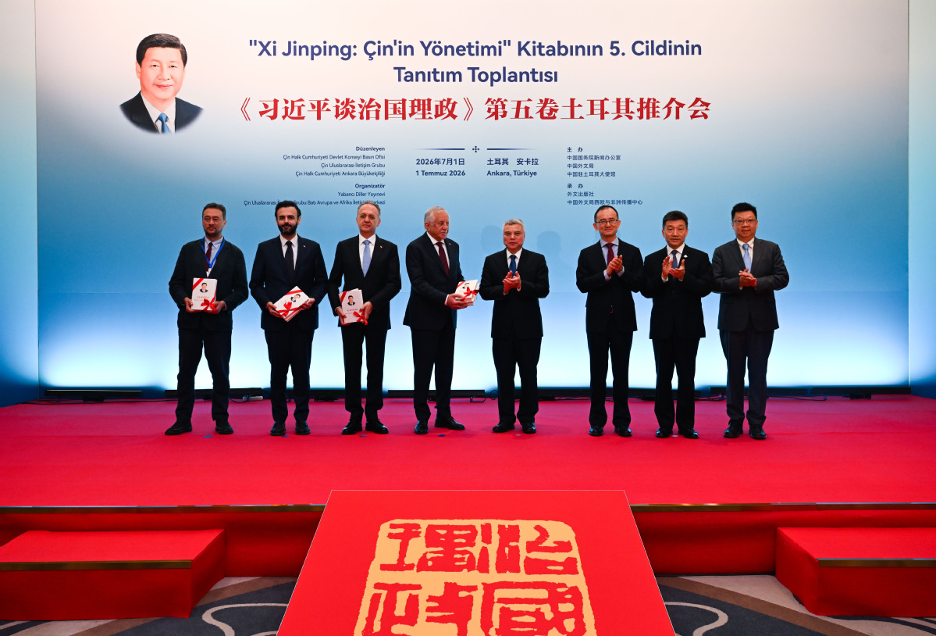
He also promoted Turkish translations of canonical Chinese texts including Dream of the Red Chamber, I Ching, Analects, and The Art of War as part of a broader effort to frame Chinese civilization as universal cultural heritage rather than an authoritarian political system. In July 2026, Jiang co-organized the Ankara launch of the fifth volume of ‘Xi Jinping: The Governance of China’ with China’s State Council Information Office, drawing Grand National Assembly of Türkiye (TBMM) Deputy Speaker Celal Adan, Deputy Minister of Culture and Tourism Gökhan Yazgı, and senior CPC officials to an event themed around Sino-Turkish modernization cooperation. The promotion of classical texts had established cultural familiarity; this event presented Xi’s governance doctrine directly to Turkish political and policy audiences as a framework for statecraft. Individually, these activities resembled ordinary public diplomacy. Collectively and within the broader context of the repression that continues in East Turkestan, they formed part of a coordinated campaign to normalize Chinese state narratives across Turkish political, institutional, cultural, and media spaces simultaneously.
Economic Leverage and Political Accommodation
Beijing’s influence campaign unfolded alongside deepening Turkish economic dependency on China. By 2025, bilateral trade had reached approximately $52 billion USD, making China Türkiye’s largest trading partner after Germany. The relationship remains highly asymmetric, with Türkiye running a trade deficit exceeding $46 billion. For every dollar Türkiye earns from China, it spends roughly nine. While Turkish exports to China are limited and largely replaceable, Chinese financing, logistics investments, industrial cooperation, and Belt and Road projects increasingly embed Chinese capital and infrastructure in strategic sectors of the Turkish economy.
The Belt and Road initiative institutionalized this asymmetry further. Following the July 2016 coup attempt, which left Türkiye diplomatically isolated and economically vulnerable, Chinese financial institutions provided loans and investment when Ankara had few comparable alternatives. Negotiations over nuclear energy cooperation deepened this dependency further, tying strategic infrastructure planning to sustained relations with Beijing.
The unratified extradition treaty signed during the first Belt and Road Initiative (BRI) Forum in May 2017 remains particularly significant for Uyghurs living in Türkiye. Its broad criminality and counterterrorism provisions create procedural conditions under which Beijing’s designation of Uyghur political activity as extremism or terrorism could intersect with Turkish legal processes despite international protection obligations. Even without ratification, the treaty continues to exert political pressure and reinforces the broader securitization of Uyghur activism inside Türkiye.
Political signaling increasingly reflects these realities. In June 2024, Foreign Minister Hakan Fidan visited East Turkestan, an unprecedented move for a NATO foreign minister, implicitly reinforcing Beijing’s portrayal of the region as a stable and economically dynamic development zone rather than a site of mass atrocities and ongoing repression.
Türkiye’s growing accommodation of Beijing is not simply rhetorical. It reflects the political logic of dependency. As economic integration deepens, the costs of confronting China rise while the institutional incentives for cooperation expand. This environment creates the conditions under which transnational repression becomes easier to operationalize, particularly against vulnerable diaspora communities already framed through the language of security, counterterrorism, and migration control.
From Influence to Transnational Repression
The consolidation of Chinese influence in Türkiye carries direct consequences for Uyghurs living there. As Beijing deepens institutional access and political leverage, the conditions that once made Türkiye a relative safe haven for Uyghurs steadily eroded. This shift did not occur through a single policy decision. It emerged gradually through migration restrictions, intelligence cooperation, surveillance operations, and the normalization of Uyghur activism as a security issue rather than a human rights concern.
The securitization of Uyghur identity in Türkiye increasingly mirrored Beijing’s own framing. The extradition treaty signed during the 2017 Belt and Road Forum reinforced this trajectory by embedding Chinese counterterrorism language into the bilateral relationship. Even without ratification, the agreement contributed to an environment where ordinary Uyghur political, religious, and cultural activity could increasingly be framed as extremism, separatism, or a national security risk, mirroring the CCP’s own securitization of Uyghur identity in East Turkestan.
The repression also became operational. In May 2025, Turkish security services dismantled a Chinese intelligence network operating inside Türkiye and seized IMSI catcher devices capable of intercepting mobile communications by mimicking cell towers. Authorities documented surveillance operations targeting Uyghur community members as well as Turkish officials. Beijing’s operatives reportedly monitored diaspora members, tracked communications, and used threats against family members inside East Turkestan to pressure Uyghurs in Türkiye into silence or cooperation. In 2020, a Uyghur man was shot and critically wounded in Istanbul days before a planned BBC interview in which he intended to describe efforts by Chinese security services to coerce him into spying on others in Türkiye.
Research from the University of Sheffield demonstrates the broader psychological consequences of this environment. Uyghurs in Türkiye increasingly reported chronic fear, social fragmentation, and widespread self-censorship. Many avoided political activities, limited communications with relatives abroad, or withdrew from public community life altogether out of concern that visibility would trigger retaliation against family members in East Turkestan. Transnational repression functions not only through detention or deportation, but through the production of permanent uncertainty.
This is the environment Beijing’s influence operations helped create. Institutional access, narrative management, economic dependency, and security cooperation collectively reduce political resistance to China’s transnational repression efforts by normalizing a more accommodating posture toward Chinese security priorities inside Türkiye. The result is a gradual transformation of Türkiye from a refuge for Uyghurs fleeing repression into a political environment increasingly shaped by the logic of the Chinese state itself.
Conclusion
Ambassador Jiang Xuebin’s tenure reflects the maturation of China’s influence operations in Türkiye from fragmented relationship-building into a coordinated system linking diplomacy, media influence, institutional access, economic leverage, and transnational repression. Jiang did not build Beijing’s influence from scratch. He scaled and institutionalized networks China spent years cultivating across Turkish political, commercial, media, and civil society.
The broader objective extends beyond defending Beijing’s policies in East Turkestan. China seeks to reshape the political environment in which the Uyghur issue itself is discussed inside Türkiye by normalizing CCP narratives, cultivating economically dependent stakeholders, and embedding Chinese interests across state institutions, media infrastructure, and elite networks. As economic integration deepens and political costs of confronting Beijing rise, Türkiye’s historical role as one of the most important centers for Uyghur political and cultural life continues to erode.
