
Türkçe versiyonu için tıklayın.
Summary
China’s influence operations in Türkiye have evolved from isolated diplomatic engagement into a coordinated, multi-layered system designed to reshape political discourse, institutional behavior, and public attitudes towards Uyghur rights. At the center of this effort is the Chinese Community Party’s (CCP) United Front Work Department (UFWD), which advances Beijing’s interests through pro-China network of politicians, business associations, Turkish language media partnerships, civil society organizations, and carefully cultivated elite capture. The Beijing-backed groups serve as the mouthpiece of the Chinese Communist Party’s narrative on issues ranging from Uyghur rights to China’s economic interests, serving two interconnected objectives: consolidating Beijing’s political and economic leverage within a key NATO member state, and eroding Türkiye’s historical role, as the haven for the plight of East Turkestan, that has been considered as the second homeland for one of the largest Uyghur diasporas globally. As China deepens institutional access and economic upper hand, the political space for Uyghur advocacy in Türkiye continues to narrow.
The present policy brief maps Beijing’s influence infrastructure in Türkiye through five interconnected public figures:
- Doğu Perinçek, head of the Patriotic Party (Vatan Partisi) which serves as the point-of-contact for the CCP’s party-to-party channel;
- Mehmet Adnan Akfırat, businessman and academic affiliated directly with state apparatus in Xinjiang Uyghur Autonomous Region;
- Sabir Boğda, a co-opted Uyghur figure who actively promotes Beijing’s narrative both in the diaspora and Turkish business and policial circles;
- Hasan Çapan, owner of CGTN Türk, Beijing a Turkish-language broadcast platform;
- and İhsan Beşer, founder of Türkiye-China Business Development and Support Association.
Background
Türkiye occupies a unique position in Beijing’s foreign policy calculus because it hosts the largest Uyghur diaspora outside of Central Asia, with an estimated 50,000 Uyghurs living across Istanbul, Ankara, Kayseri, and Izmir. The actual number might be much higher considering the naturalized Turkish-Uyghurs who have settled in the country over the last century. Shared linguistic, religious, historical, and cultural ties have long made Türkiye a principal destination for Uyghurs fleeing repression following China’s occupation of East Turkestan, officially called the Xinjiang Uyghur Autonomous Region. For decades, Uyghur communities in Türkiye preserved their cultural identity, documented abuses, and maintained international visibility on the situation in East Turkestan.
As Chinese authorities systematically blocked independent reporting from East Turkestan, the Uyghur diaspora in Türkiye became a critical source of firsthand testimony regarding mass arbitrary detention, forced labor, family separation, and cultural erasure in East Turkestan. That function made the Uyghur diaspora as one of the most targeted communities by the Chinese government’s transnational repression. Türkiye is among the “26 sensitive countries”, a designation used by Chinese authorities to flag Uyghurs with ties to primarily Muslim-majority states and treat contact with these countries as grounds for political suspicion. Since 2016, the Chinese government interrogated, arbitrarily detained, or imprisoned Uyghurs who studied, worked, or traveled to Türkiye, or communicated with relatives there.
Ankara has historically been vocal on Uyghur, yet China’s increasing influence and pressure is evident. For much of the past two decades, the Turkish government publicly positioned itself as a critic of Beijing’s human rights violations in East Turkestan. In July 2009, then-Prime Minister Recep Tayyip Erdoğan described China’s violent suppression of protests in Urumchi as “genocide,” triggering sharp diplomatic backlash from Beijing and briefly straining bilateral relations. A decade later, in early 2019, Foreign Minister Mevlüt Çavuşoğlu raised the issue at the UN Human Rights Council, expressing concerns over human rights violations in the region, calling on Chinese authorities to ensure protection for the religious freedom and cultural identities of Uyghurs and other Turkic communities. Türkiye has also expressed similar concerns, several times, at the international level and foreign ministry statement at least until 2022. Yet Ankara’s position revealed a pattern of ambiguity. Despite strong rhetoric, Türkiye avoided sustained institutional confrontation with Beijing at platforms such as the Organization of Islamic Cooperation, despite mounting evidence of mass detention and abuses amounting to genocide. Türkiye reiterated concerns at the UN General Assembly’s Third Committee in October 2020, however, it declined to join the joint statement of thirty-nine other countries condemning Beijing’s policies, instead issuing a separate national statement.
In recent years, the Turkish government has sidestepped the Uyghur rights in their engagements with China. Turkish officials raised the Uyghurs’ plight when domestic pressure demanded it but offered institutional silence when bilateral interests were at stake. Even at the domestic level, many Uyghurs living in Türkiye faced immigration restrictions and deportation orders, striking contrast to the preferential treatments Uyghurs have enjoyed.
Despite shifting government policies toward China, Türkiye remains a country highly sensitive to the East Turkestan plight. A 2022 Kadir Has University survey found that willingness to actively support Uyghurs even at the cost of bilateral economic relations with China, while declining, remained present across all major political party supporters, reflecting broad public sympathy that transcends party lines. This persistent public sensitivity is precisely why Beijing’s influence operations in Türkiye focus heavily on shaping the Uyghur narrative.
The United Front Work Department
At the center of Beijing’s foreign influence architecture is the United Front Work Department (UFWD), a CCP Central Committee organ responsible for cultivating influence among non-Party actors abroad, including diaspora communities, foreign political parties, business elites, media organizations, academics and civil society networks. The UFWD seeks to gradually reshape political environments in ways that advance Beijing’s interests while increasing the cost of criticizing of China.
The UFWD operates through a layered system of formally independent organizations, including friendship associations, chambers of commerce, cultural institutions, think tanks, and academic exchange programs that outwardly resemble routine civil society activity but function as transmission channels for CCP messaging. The system works gradually, normalizing pro-Beijing narratives, cultivating long-term relationships, and integrating influential political, business, and media actors into China-aligned networks even before issues affecting Beijing’s interests emerge.
Two subordinate bodies are particularly significant in the Turkish context. The Council for the Promotion of Peaceful Reunification of China (CPPRC) that works to mobilize Chinese diaspora networks in support of Beijing’s policies and the Chinese People’s Association for Friendship with Foreign Countries (CPAFFC) which manages “people-to-people” and “city-to-city” diplomacy through partnerships with municipalities, universities, business associations, and civil society organizations. Together, the CPPRC and CPAFFC aim to transform economic, cultural, and diplomatic engagement into channels for political influence and narrative management.
The UFWD relies heavily on what Chinese doctrine calls “inviting in and going out.” Party officials travel abroad to identify and cultivate promising actors while Chinese institutions bring foreign elites to China through carefully managed exchanges, tours, conferences, and partnership programs. The UFWD specifically targets business figures with commercial ties to China, media personalities with public reach, academics with institutional credibility, and political actors capable of advancing Beijing’s narratives while appearing to speak independently.
Türkiye became a particularly important arena for these operations because it combined three dynamics Beijing viewed as strategically significant: a large and politically active Uyghur diaspora, growing Turkish economic dependence on China, and increasing geopolitical tensions between Ankara and Western allies.
Examples of Beijing’s Influence Infrastructure in Türkiye
Beijing has been constructing overlapping networks of political, economic, media, and civil society influence in Türkiye. Below is a network of actors that Beijing cultivated over years which are increasing their capacity to shape Turkish political discourse on China, countering Uyghur advocacy, and expanding institutional access in Türkiye for China’s interests.
Doğu Perinçek
Doğu Perinçek is a traditional and most well-known ally of the Chinese Communist Party in Türkiye, who is the founder and leader of Patriotic Party (Vatan Partisi). Perinçek has maintained formal ties with the CCP since the 1970s through direct engagement with the CCP’s International Liaison Department, the party organ responsible for cultivating relations with foreign political parties and ideological partners. Although the Patriotic Party holds no parliamentary seat today, it maintains media influence through outlets including Aydınlık, Ulusal Kanal, Oda TV, and Yön Radyo, all of which regularly push pro-Beijing narratives to Turkish audiences.
On East Turkestan, the Patriotic Party affiliates consistently frame CCP policy as legitimate “counterterrorism” while portraying Uyghur diaspora activism and international human rights advocacy as separatism and Western geopolitical manipulation. The relationship between the Patriotic Party and the CCP operates openly. In February 2019, less than two weeks after Türkiye’s Foreign Ministry issued a statement raising concerns over China’s policy in the Uyghur Region, the CCP’s International Liaison Department hosted a Patriotic Party delegation in Beijing led by Perinçek. During the meeting, both sides pledged to deepen cooperation, and CCP officials explicitly defended China’s ethnic and religious policies in the East Turkestan.
This pattern has continued without interruption. In December 2020, newly appointed Ambassador Liu Shaobin made Perinçek the first Turkish politician he visited upon taking office. In June 2024, a CCP Central Committee International Department delegation visited Vatan Partisi’s Istanbul branch, where Perinçek declared that the two parties “share over 60 years of friendship.” In November 2024, an eight-person delegation from Xinjiang visited Vatan Partisi headquarters in Istanbul, with Perinçek publicly describing Xinjiang as “a bridge of civilization and friendship between China and Türkiye.” More recently, in June 2025, Ambassador Jiang Xuebin met Perinçek and described him as ‘an old friend of the Chinese people who has made long-standing contributions to the friendship between China and Türkiye,’ while discussing the advancement of party-to-party exchanges.
Mehmet Adnan Akfırat
Mehmet Adnan Akfirat served as the Patriotic Party’s official representative to China until 2023 while simultaneously building an extensive business and institutional network tied directly to Chinese state structures.
Akfirat founded the Turkish-Chinese Business Matching Center (TUCEM) in 2006 and now chairs the China Business Development and Friendship Association (Türk-Çin İş Geliştirme ve Dostluk Derneği) since November 2007. Akfırat also serves as the official representative of the Silk Road Think Tank Association in Türkiye, a platform founded by the International Department of the Communist Party of China Central Committee (IDCPC) and conducting high-level dialogue and policy research on Eurasian cooperation. Since 2019, he has served as a visiting researcher at Shihezi University’s Silk Road Center, an institution administered by the Xinjiang Production and Construction Corps (XPCC). The XPCC is a paramilitary-administrative body established in 1954 that functions as a parallel governing system combining governmental, judicial, security, economic, and corporate authority across Xinjiang. Scholars describe it as a ‘state within a state.’ As documented in Uyghur Rights Monitor’s recent analysis, the XPCC has served as a central institutional vehicle of demographic reengineering and repression in East Turkestan.
Akfırat’s ties to the state apparatus in East Turkestan are direct and extensive. In July 2022, he led a multi-country foreign business delegation to Xinjiang, where the group was received by Xinjiang Party Secretary Ma Xingrui and Chairman Adil Tuniyaz in Urumchi. During the meeting, Ma presented Xinjiang as stable, prosperous, and open to investment, while Akfırat and other delegation members publicly stated that Western allegations about Xinjiang were “utterly absurd” and pledged to promote Xinjiang’s achievements in their respective countries. Akfırat later wrote that during the July 2022 meeting, Ma Xingrui personally invited him to play a role in developing Xinjiang’s relations with Türkiye. In 2023, acting on that invitation, Akfırat organized trade events at the Horgos International Free Zone alongside local CCP officials, including a special fair and fashion show involving fifty Turkish and European clothing brands.
In December 2024, Akfırat spoke at an international symposium on employment and social security in Xinjiang, organized to rebut Western allegations of forced labor, where he appeared alongside guests from 44 countries and international organizations and was received by Ma and Tuniyaz. Akfırat is also a 30% shareholder of China-Türkiye Lecanrong (Xinjiang) Trade Development Inc. (中土乐灿嵘(新疆)贸易发展有限责任公司), with the remaining 70% held by 中土正灿嵘(新疆)贸易发展有限责任公司, a joint venture established with the support of the Xinjiang Uyghur Autonomous Region Government and inaugurated in February 2025 with participation from Türkiye’s Deputy Minister of Trade, Mahmut Gürcan.
In February 2026, Akfırat’s association formalized this institutional embeddedness further. During a Chinese trade delegation to Türkiye led by China Council for the Promotion of International Trade (CCPIT) Chairman Ren Hongbin, the Xinjiang Production and Construction Corps Trade Promotion Council signed a formal cooperation memorandum with Turkey-China Business Promotion and Friendship Association. The agreement formalized direct institutional ties between a Turkish civil society association and the trade promotion arm of China’s largest paramilitary organization in East Turkestan.
Akfırat has also emerged as one of the most visible defenders of Beijing’s policies in East Turkestan. Chinese state media including Xinhua, People’s Daily, and China Daily regularly publish his commentary, presenting him as an independent foreign observer praising China’s development model and deflecting Western criticism. In these columns, he has denied that mass atrocities are taking place, defended the Chinese government’s’ genocide against Uyghurs. Recently, he has also praised China’s Ethnic Unity and Progress Law, which mandates cultural assimilation and restricts the religious and cultural expression of Uyghurs and other Turkic peoples.
These engagements serve a clear function: it is what the UFWD’s elite capture strategy is designed to produce. By combining commercial partnerships, academic credentials, institutional ties, and public advocacy, Akfırat exemplifies the type of elite engagement the United Front Work Department seeks to cultivate: an influential foreign actor capable of lending local credibility to Beijing’s messaging while deepening institutional ties with Chinese state structures.
Sabir Boğda
Beijing’s influence strategy also relies on selectively cultivating Uyghur figures willing to publicly legitimize Chinese policy. In Türkiye, the most visible example is Sabir Boğda, the founder of the Turkish Uyghur Industrialists and Entrepreneurs Association (土耳其维吾尔工商业者协会, Uygur Sanayici ve İşadamları Derneği – UYSİD). Boğda, a PRC-born Uyghur businessman, served as a non-voting delegate to both China’s national Chinese People’s Political Consultative Conference (CPPCC) in 2015 and to Xinjiang’s regional CPPCC in 2016, positions associated with political reliability and alignment with CCP priorities. He has since held additional positions in national and regional-level united front organizations in China, including as a council member of the China Overseas Friendship Association (COFA) in 2019.
Through business forums and media appearance, Boğda has consistently framed Türkiye’s engagement with Xinjiang authorities as an economic opportunity while deflecting attention from the ongoing genocide. In 2015, UYSİD vice-president Volkan Öztürk told Chinese state media that protests China’s Ramadan restrictions were instigated by “individuals who have ulterior motives.” More recently, following Türkiye’s 2026 visa exemption decree for Chinese citizens, Boğda publicly praised Chinese Ambassador Jiang Xuebin and called on Uyghurs to act as a “bridge” between the two countries.
This function is politically significant. A Uyghur figure publicly endorsing Beijing’s policies carries a legitimacy that Han Chinese officials cannot replicate. Beijing’s objective is to fragment diaspora representation by elevating state-aligned actors capable of projecting compliance and normalcy.
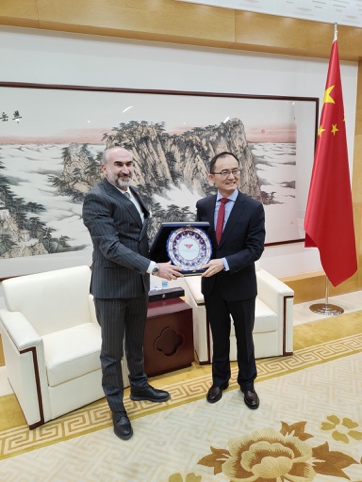
The network’s interconnected structure became particularly visible in December 2023 when a delegation from the Horgos International Trade Chamber visited Istanbul and met jointly with Akfirat and Boğda under the coordination of the Chinese Consulate General in Istanbul. Consul General Wei Xiadong formally received the delegation, illustrating how Chinese diplomatic missions, Xinjiang trade bodies, business intermediaries, and CCP-aligned diaspora figures like Boğda operate as overlapping components of the same influence architecture.
Hasan Çapan and Turkish Language Chinese Propaganda
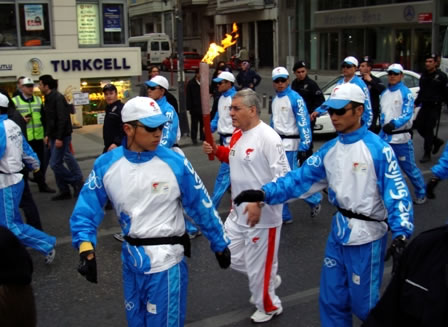
Hasan Çapan’s ties to the China date back to the late 1980s through business cooperations. In 2008, Beijing selected him as an Olympic torchbearer during the Beijing Olympics relay in Istanbul. The following year, he founded the Türkiye-China Friendship Foundation (Türkiye Çin Dostluk Vakfı – 土耳其中国友好基金会), which later formalized cooperation agreements with both the Chinese People’s Association for Friendship with Foreign Countries (CPAFFC) and the China International Publishing Group (CIPG), two key CCP propaganda institutions. Notably, the Foundation’s then-Vice President Mehmet Ali Yaşar disclosed in a podcast that the Foundation has received financial support from the Chinese embassy.
Çapan also runs the Center for New World Studies (Yeni Dünya Araştırmaları Merkezi – YDAM), which functions as a Turkish language content production platform aligned with Chinese state narratives. In September 2025, he organized a Turkish media delegation to East Turkestan together with the Chinese Consulate General in Istanbul. Delegates subsequently produced denialists articles by YDAM and amplified by Chinese state media, while Çapan himself appeared in Chinese broadcasts dismissing the Uyghur genocide as Western fabrication. Chinese consular social media then emphasized his Turkish identity as proof of the credibility of the message itself. Ambassador Jiang Xuebin’s first documented bilateral meeting after arriving in Ankara was with Çapan, whom he publicly described as an “old friend of the Chinese people.”
These trips follow a documented pattern. As detailed in Uyghur Rights Monitor’s recent investigation, Beijing has shifted from restricting access to the Uyghur Region toward managed exposure, inviting curated visits under scripted conditions designed to produce content that projects normalcy while denying access to anything that contradicts the official narrative. This relies on what Chinese state discourse calls ‘borrowing mouth to speak’ (借嘴说话), using foreign visitors as ostensibly independent validators of claims Chinese officials cannot credibly make themselves.
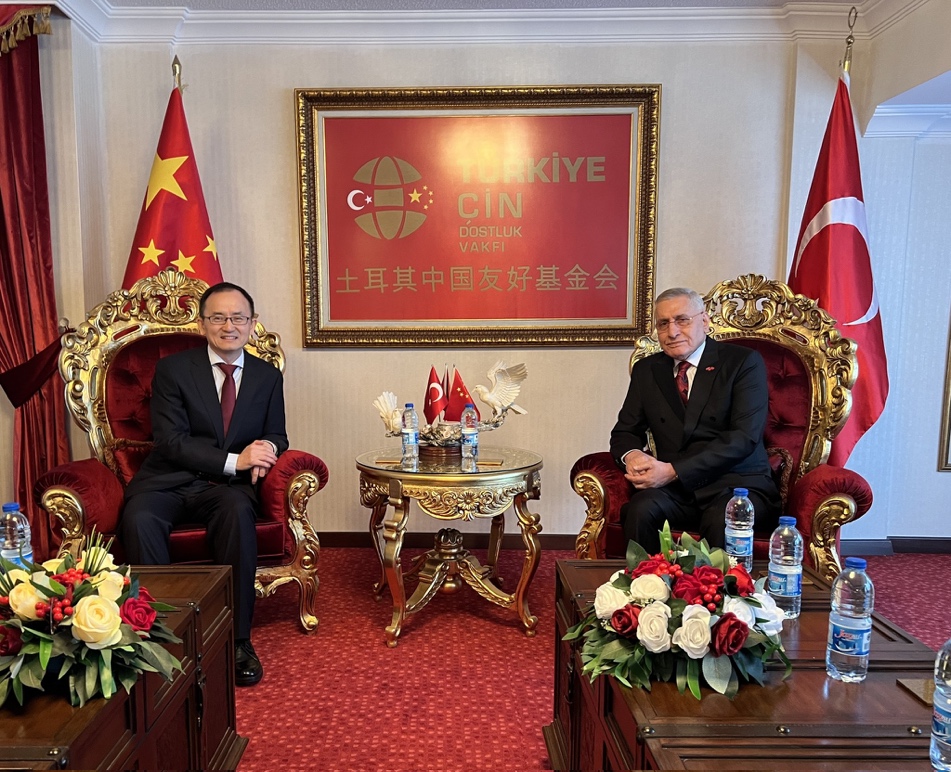
Çapan, also operates CGTN Türk, the Turkish-language network of China Global Television Network (CGTN), through his private company (HC İletişim Medya Yayıncılık A.Ş). CGTN Türk functions effectively as the Turkish language extension of China Media Group, which sits directly under the CCP Central Propaganda Department. CGTN Türk broadcasts across more than 30 Turkish FM frequencies.
As research demonstrates, Chinese state media including CGTN, Global Times, China Daily, and People’s Daily produce almost no Turkish-language content, leaving Xinhua and China Radio International (CRI) as China’s only outlets capable of reaching Turkish audiences directly. Beijing has compensated by working through Turkish intermediaries instead: paying for advertorials in mainstream newspapers including Hürriyet, Sabah, and Cumhuriyet, and organizing press tours that bring Turkish journalists to East Turkestan to propagate Beijing’s narratives.
İhsan Beşer and Beijing’s Commercial Influence Network
İhsan Beşer entered China’s network through agricultural trade, initially exporting Turkish cherries to Chinese markets beginning in 2012. By 2018, he founded the Türkiye-China Business Development and Support Association (TC-İSGED), which he publicly described as operating with support from both Turkish and Chinese governments. In 2025 he called it a “PRC-accredited association operating in Türkiye.”
TC-İSGED functions primarily as an access infrastructure connecting Chinese diplomatic, commercial, and political actors with Turkish provincial authorities, business networks, and government institutions. Beşer cultivated unusually close ties with multiple successive Chinese ambassadors, documenting his meetings with each on TC-İSGED’s website. He organized industrial tours to Afyonkarahisar, one of Türkiye’s leading provinces in agriculture, and arranged repeated meetings between Ambassador Jiang and Turkish officials, including leadership of the ruling Justice and Development Party (AKP), provincial governors, and business elites.
Beşer’s organization also operates TurkiyeChinaNews.com, a Turkish language platform largely republishes Chinese state-media content under a Turkish masthead with minimal attribution. Its coverage systematically reproduces development focused narratives on East Turkestan, aligned with Beijing’s messaging, and whitewashes the Uyghur genocide.
United Front Work as a National Security Concern
Across multiple countries, intelligence services and prosecutors have identified United Front-linked networks as direct threats to national security, ranging from covert political donations and recruitment of officials to active espionage operations against diaspora communities.
For example, in the United Kingdom, MI5 issued a formal interference alert in January 2022 naming solicitor Christine Lee as an agent “knowingly engaged in political interference activities” on behalf of the UFWD, the first time a British security agency had publicly named the organization. In November 2025, MI5 issued a further warning that Chinese intelligence operatives were using LinkedIn profiles at scale to cultivate long-term relationships with MPs, think tank analysts, and government officials. The UK government subsequently ordered an independent review into foreign financial interference in British politics.
Türkiye itself has not been exempted from this pattern. In February 2024, Turkish intelligence (MİT) detained six individuals in Istanbul accused of espionage on behalf of Chinese intelligence services, systematically gathering information on prominent Uyghurs community leaders and Uyghur organizations in Türkiye. One defendant, Memeteziz, received payment from Chinese handlers in Beijing and Saudi Arabia and was instructed to relocate near a prominent Uyghur religious figure to gather intelligence on him. In May 2025, MİT dismantled a substantially more sophisticated network: seven Chinese nationals operating “ghost base stations,” IMSI-catcher devices disguised as legitimate cell towers, across five Turkish cities including Istanbul, Izmir, and Bursa, to intercept the communications of both Uyghur dissidents and Turkish government officials. Investigators described it as one of the most technically advanced foreign espionage operations uncovered on Turkish soil.
Conclusion
Over the past decade, Beijing has built an interconnected influence infrastructure spanning political parties, business networks, media platforms, civil society organizations, and pro-CCP diaspora figures capable of reproducing its narratives and advancing its interests through seemingly domestic channels. Together these actors help whitewash China’s genocide in East Turkestan, marginalize Uyghur advocacy, and steadily increase the political and economic costs of publicly confronting Beijing in Türkiye. As the CCP’s leverage deepens through trade, infrastructure, media partnerships, and elite cultivation, Türkiye’s historic role as one of the most important centers for Uyghur political and cultural life outside of the Uyghur homeland continues to erode.
This erosion carries direct consequences for hundreds and thousands of Uyghurs who call Türkiye home. The Turkish government should ensure protection for Uyghurs by establishing proper mechanisms to address China’s transnational repression. It should also publicly confront Beijing about the Uyghur genocide and press Xi Jinping government to end its atrocities in East Turkestan. Turkish government should also investigate United Front operations in Türkiye and investigate actors who are complicit in Chinese government repression, by promoting CCP’s narrative and targeting Uyghur activists and organizations based in Türkiye.
