

By Ablet Turdi
Key Findings:
- Natural population growth in the Uyghur Region declined sharply after 2017 as regional population increase shifted from birth rates among Uyghur and other Turkic peoples to Han migration from inner China.
- The strongest Han settler migration appears in XPCC-administered areas. Official XPCC statistics indicate that between 2019 and 2022, 96 to 99 percent of XPCC population growth came from in-migration rather than births.
- The XPCC offers Han migrants from inner China employment, hukou transfer[1], housing subsidies, land access, and family benefits, transforming settlement into a mechanism of demographic reengineering tied to land control, labor supply, and state production.
The XPCC as a Settler-Colonial Institution
The Xinjiang Production and Construction Corps (XPCC), or Bingtuan, emerged in October 1954 after the Chinese Communist Party occupied East Turkestan, now the Xinjiang Uyghur Autonomous Region, in 1949. The XPCC functions as a parallel governing system nominally under regional authority but largely accountable to Beijing. Scholars often described it as a “state within a state” because it combines governmental, judicial, security, economic, and corporate authority across its jurisdiction.
From its founding slogan to “reclaim and defend the frontier,” the XPCC has played a role as a military-style institution of settlement, production, and administration. Through its “division-city” and “regiment-town” model, XPCC divisions and regiments exist simultaneously as municipalities and quasi-military governing organs, exercising authority over land, policing, courts, prisons, farming, industry, and trade.
The XPCC’s integrated structure also makes it a central institutional vehicle of genocide in the Uyghur Region. Its police, courts, prisons, regiments, farms, and enterprises do not operate separately. Together, they form a system that surveils, detains, sentences, dispossess, and economically exploits Uyghurs and other Turkic peoples. XPCC-linked institutions have been tied to mass internment, prison expansion, coercive labor transfers, and the criminalization of ordinary cultural and religious life. These systems convert repression into economic production by linking Uyghur detention and displacement to XPCC-run farms, factories, prisons, and industrial parks.
The XPCC’s settler-colonial role is also visible in its disproportionate control over land and production. Although it administers only about 4.2 percent (70,600 km2) of the Uyghur Region’s territory (1,664,900 km2), it controls approximately 20 percent (1.48 million hectares) of the region’s cultivated land (7.07 million hectares) by September 2023. This gives it disproportionate influence over agricultural production, land allocation and rural development. In 2023, XPCC’s Gross Domestic Production (GDP) reached approximately RMB 369.7 billion(approximately 52 billion USD), accounting for 19 percent of the regional economy, while its enterprise network included more than 4,000 companies. The XPCC, therefore, is also a state-owned conglomerate that reorganizes land into a system of settlement, production, and state control.
This institutional structure also affects demographics of the region. Population data since 2017 shows how the XPCC continues to facilitate state-directed Han settlement into the Uyghur Region.
Han Chinese Influx into the Uyghur Region
Chinese state narratives frequently cite aggregate population growth in the Uyghur Region to deny or minimize the demographic impact of genocidal policies against Uyghurs and other Turkic peoples. However, total population growth obscures the more important question: who is driving that growth.
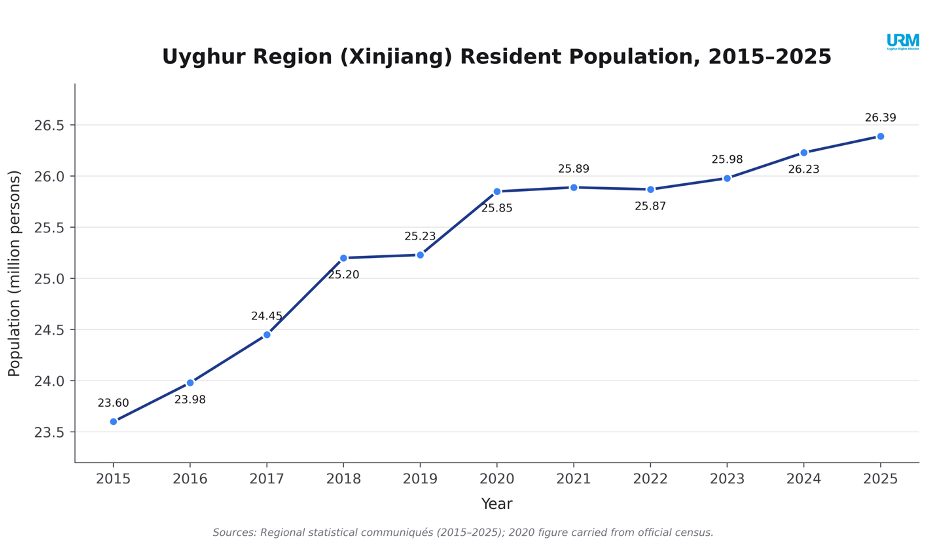
In 2021, the Chinese government claimed that the region’s population grew from 21.8 million in 2010 to 24.9 million in 2018, attributing much of that growth to Uyghurs. Officials used this argument to counter research documenting sharp declines in Uyghur birth rates.
The 2020 Seventh National Population Census presents a different picture. It reported the region’s total population at 25.85 million, about 4.04 million higher than 2010. Over that decade, the region’s Han Chinese population increased by 2.174 million, of which 1.948 million resulted from interprovincial migration. In other words, nearly 90 percent of Han population growth came from migration from other provinces. The central demographic shift is the replacement of natural local population growth with large-scale Han settler migration.
Official Xinjiang Uyghur Autonomous Region (XUAR) statistical data shows that before the escalation of the “Strike Hard” campaign in 2017, regional population growth was largely explained by natural increase, births minus deaths. In 2016, natural growth accounted for roughly 70 percent of the region’s total population increase. Given that nearly 90 percent of Han population growth between 2010 and 2020 came from migration, where net migration can be found from total population change minus the natural increase, this earlier natural growth largely reflected births among Uyghurs and other Turkic communities rather than Han settlers.
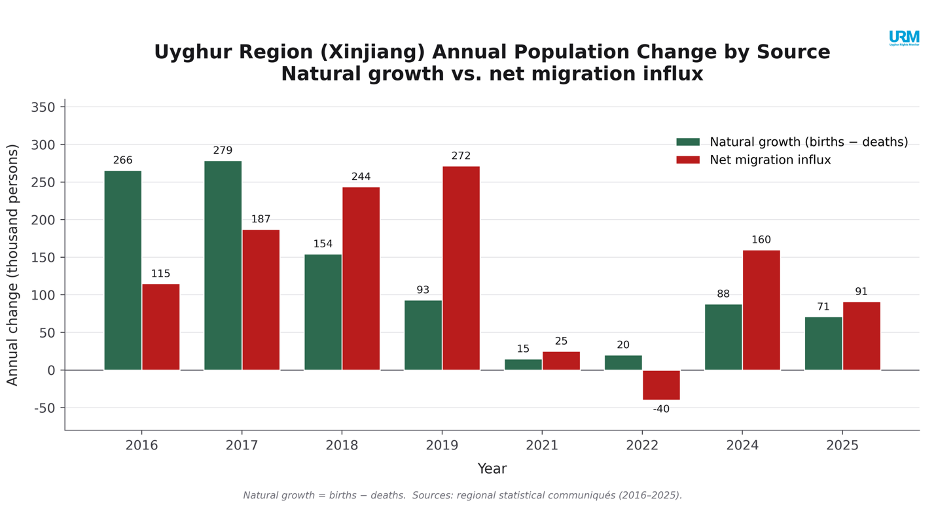
After 2017, the pattern changed dramatically. Natural growth collapsed, yet the total population continued to climb. By 2019, natural growth accounted for only about 25 percent of the region’s population increase, down from 70 percent three years earlier. Natural growth accounted for roughly 35 percent growth in 2024 and 44 percent in 2025. The data indicates that population growth now increasingly depends on migration into the region rather than births among local communities.
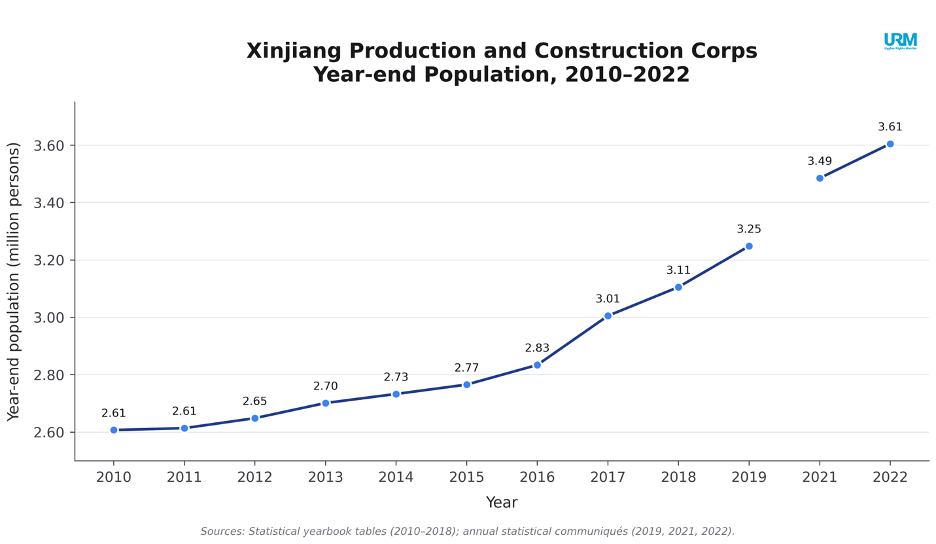
The XPCC sits at the center of this demographic transformation because it provides the institutional infrastructure for state-directed settlement. Since its establishment, the XPCC has functioned as a vehicle for state-organized Han settlement in the Uyghur Region. Its founding population consisted overwhelmingly of Han migrants mobilized from People’s Liberation Army (PLA) units, former Nationalist troops, educated youth, and relocated workers from inner China. From 175,000 people at its founding (3.6% of the total population), the XPCC population grew to 2.36 million by 1997 (amounting to 13.7% of total population).
This settlement function accelerated again after the launch of the “Strike Hard” campaign in 2016. Annual XPCC population growth since 2016 has occurred at roughly four times the rate recorded between 2010 and 2015. XPCC-specific data show the pattern even more clearly: in 2019, 2021, and 2022, more than 96 percent of XPCC population growth came from net migration rather than births, reaching 99.5 percent in 2022, meaning the population growth inside the XPCC wholly depended on in-migration during these years. The XPCC is therefore expanding almost entirely through continued Han migrants from elsewhere in China.
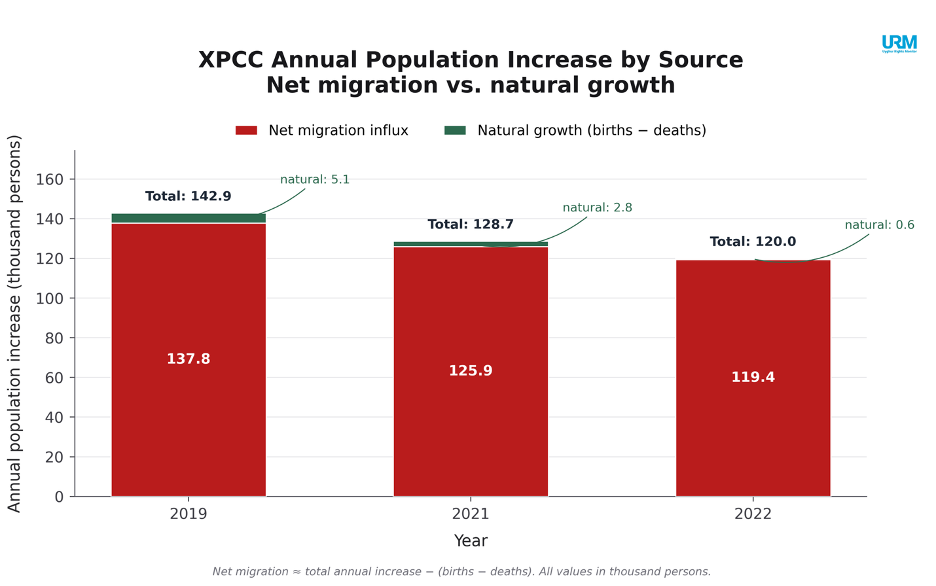
Taken together, the regional and XPCC data indicate a clear demographic transformation after 2017. Han migration increasingly replaced Uyghur and other Turkic communities’ natural growth as the principal source of population increase, particularly inside XPCC-administered areas. These shifts are not incidental. Rather, they reflect the measurable demographic outcome of genocidal policies that simultaneously suppress indigenous population growth while channeling Han settlement into the region.
Recruitment Architecture and Material Incentives
The XPCC no longer relies on Mao-era mass mobilization campaigns. Instead it increasingly uses incentive-based settlement policies to convert labor recruitment into permanent demographic incorporation.
These policies primarily target Han Chinese hukou holders from inner China and bundle employment with hukou transfer, housing subsidies, land access, welfare benefits and family relocation support. On the surface, such measures resemble ordinary labor-market recruitment. In practice, they transform labor migration into long-term settlement and demographic engineering. By linking employment to land, welfare, education, and permanent residency, the XPCC embeds incoming Han workers into its settlement and economic system.
This recruitment and settlement model aligns with Dilnur Reyhan’s analysis of Chinese settler colonialism in the Uyghur Region. Reyhan argues that describing the native population as a “minority” obscures the colonial relationship between the Chinese state and the Uyghur homeland. XPCC recruitment policies operationalize this process. While the state suppresses Uyghur and other Turkic population growth, it simultaneously offers Han migrants incentives that permanently embed them into the land, economy, and governance structure of the Uyghur Region.
Conclusion
The XPCC’s demographic, territorial, and economic functions operate together as a unified system of state control in the Uyghur Region. Settlement policies channel Han migrants into the region, economic projects anchor them through land and employment, and XPCC governance structures institutionalize their long-term presence. Demographic engineering and economic restructuring therefore reinforce one another: the XPCC reorganizes land, labor, and production around permanent Han settlements while marginalizing Uyghur and other Turkic communities.
The XPCC’s methods evolved from earlier mass mobilization campaigns to contemporary systems built around recruitment incentives, hukou transfer, housing subsidies, welfare support, and education benefits. The underlying function, however, remains consistent: attract Han migrants, transform them into settlers, and integrate them into XPCC-controlled land, production, and administration.
Governments should respond accordingly. The United States has already sanctioned the XPCC, while the United Kingdom, European Union, and Canada sanctioned the XPCC Public Security Bureau for their complicity in atrocity crimes against Uyghurs. Governments should expand these measures through targeted sanctions, import bans, customs enforcement, and mandatory supply-chain restrictions covering XPCC entities, subsidiaries, and commercial partners. Policymakers should treat the XPCC as a state-backed settler-colonial institution that plays a key role in the genocide against Uyghur people.
[1] Hukou is China’s household registration system, which ties a person’s access to public services, schooling, healthcare, and legal residency rights to a specific locality. Transferring one’s hukou to Xinjiang is therefore not a minor administrative act. It is a permanent reassignment of a settler’s life and entitlements to the frontier, designed to make Han migration durable rather than temporary.
